Agent Systems: Choosing and Composing Patterns
Figures
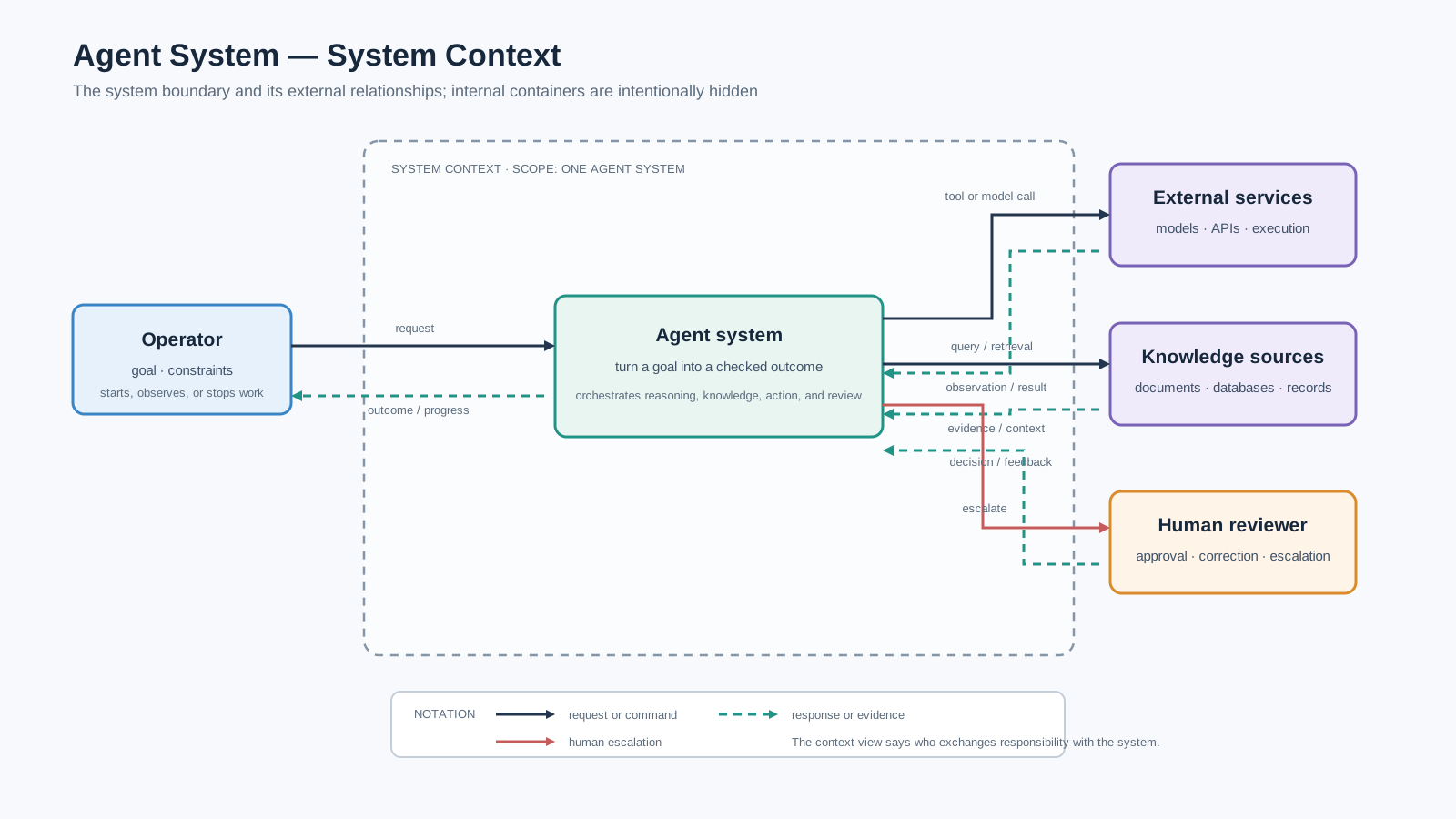
Figure: the context view shows the agent system as one unit and labels its external relationships.
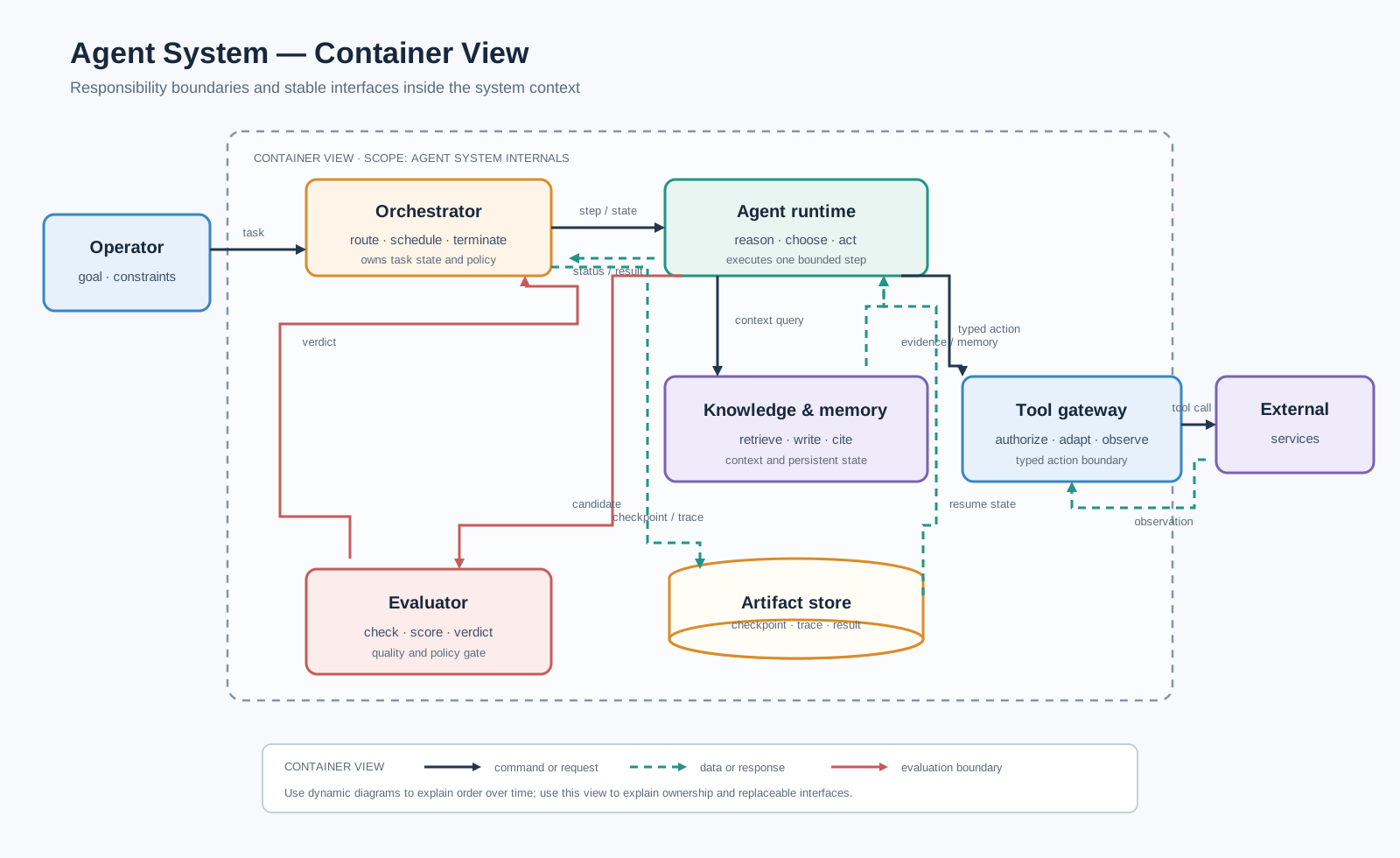
Figure: the container view expands the boundary into replaceable responsibilities and labels the interfaces between them.
In one sentence. Begin with the smallest deterministic structure that meets the requirement, and add a pattern only against a named source of complexity.
Start with the task shape
Place the task on the workflow–autonomy spectrum: fixed workflow, bounded loop, or open-ended delegation. Then identify the dominant difficulty: decomposition, specialization, uncertainty, long context, coordination, reliability, or cost.
Selection rule
Start with the smallest deterministic structure that meets the requirement. Add a pattern only when it addresses a named source of complexity. Compare candidate designs by correctness, latency, cost, observability, reversibility, reliability, and ease of revision.
Useful compositions
- chaining + structured output for staged transformations;
- router + specialized tools for heterogeneous requests;
- plan + memory + checkpoints for long-horizon work;
- parallelization + aggregation + evaluation for independent alternatives;
- retrieval + provenance + reflection for source-sensitive answers;
- multi-agent cooperation + human delegation for high-stakes decisions.
Anti-patterns
Do not add agents merely to sound autonomous, use retrieval without an applicability check, or add reflection without a stopping rule. More components increase coordination surfaces and failure modes.
Design questions
What is uncertain? Which interface makes it observable? What is the simplest pattern that provides that interface?
Read the architecture at multiple levels
Do not ask one diagram to answer every architecture question. Read the views in order:
- Context: who exchanges responsibility with the agent system?
- Container: which internal responsibilities own orchestration, runtime, knowledge, action, evaluation, and persistence?
- Dynamic: in what order do messages, decisions, parallel branches, and feedback occur? The sequence and workflow pages provide these views.
- Operations: which gateways, fallbacks, checkpoints, and evaluators make the design reliable in production?
The same system can therefore be structurally complicated without becoming conceptually muddled. Keep the visual language stable, but choose the diagram form that matches the relation being explained.
Real-world application
For a customer-support or repository-maintenance system, begin with the failure that matters: misrouting, unsafe side effects, missing evidence, or an unreviewed result. Select the smallest composition that exposes that failure, then add parallel workers, memory, or reflection only when the workflow needs their contract.
Reference basis
The selection principle follows Dibia, Designing Multi-Agent Systems, Chapter 2, Sections 2.1–2.4, and Anthropic’s Building effective agents, which recommends simple composable workflows before adding autonomous complexity.