Agent Systems: Deep Search Pattern
Figure
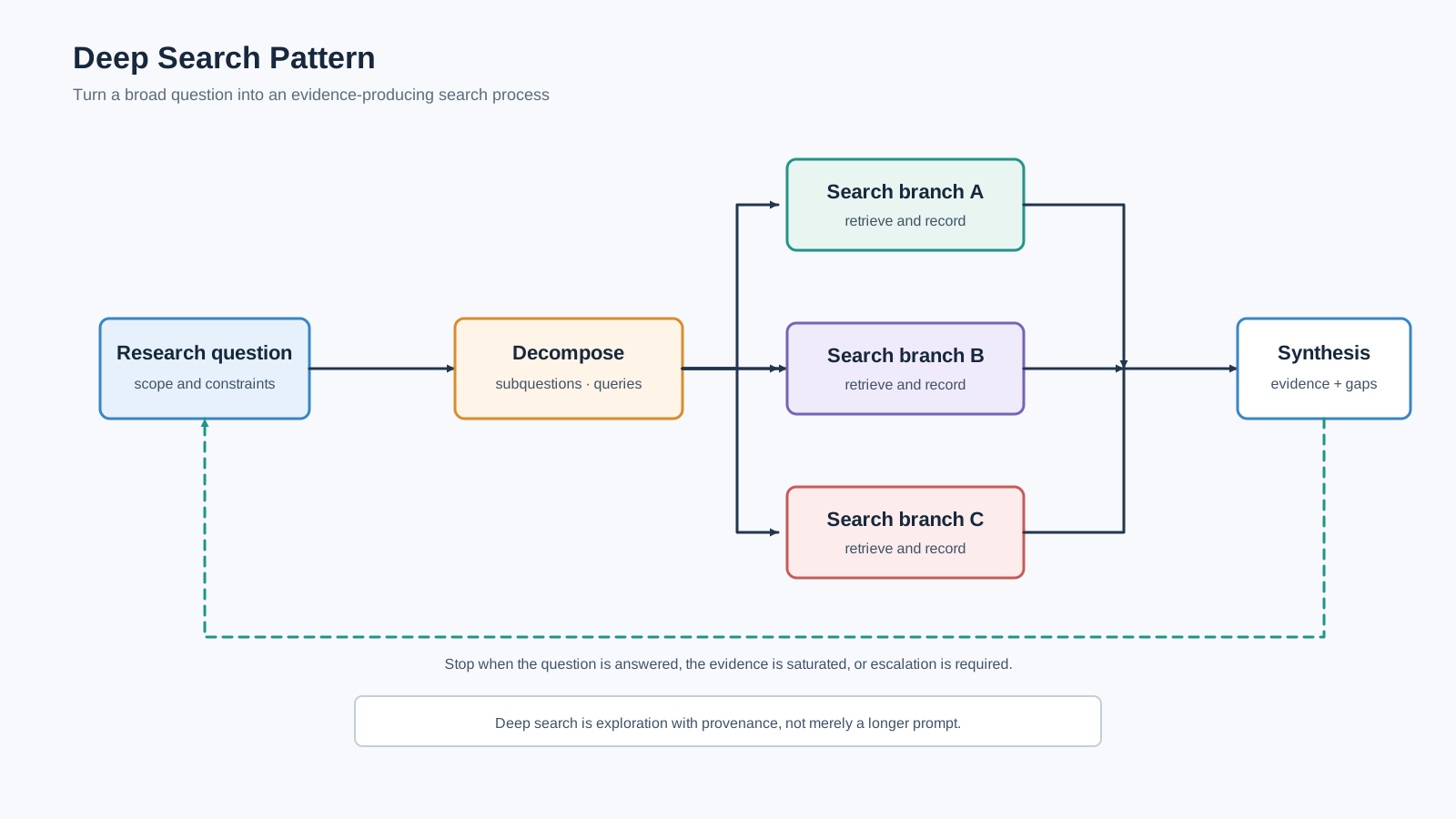
Figure: a teaching redraw of the Deep Search control structure. Retrieval, generation, and thinking are separate stages; the two decisions make budget and evidence coverage explicit; reflection produces the next subqueries.
In one sentence. Decompose a broad question, gather evidence across rounds, and stop on a stated criterion rather than on the first plausible answer.
Problem
The first query is usually underspecified and retrieves only the obvious material. A broad question needs controlled decomposition and repeated evidence collection.
Intent and structure
question → subquestions → search branches → inspect sources → refine → synthesize
Each branch should record its query, selected source, relevance judgment, extracted claim, and unresolved question. The synthesis step must distinguish direct support, nearby technique, contradiction, and open gap.
Relation to ordinary retrieval
Basic retrieval answers one context-selection problem. Deep search adds a research policy: decide what to search next based on what the last search taught the system. It therefore composes retrieval, reflection, routing, and a stopping rule.
Mathematical stopping rules
Stop when the requested coverage is reached, new searches repeat known results, the time or query budget is exhausted, or a human decides that the remaining uncertainty is the actual research problem.
Failure modes
Search can become a loop, confirmation bias can narrow the branches too early, and citation count can be mistaken for mathematical relevance. Keep a search log and preserve negative results.
Real-world application
For a market, technical, or literature investigation, the coordinator can decompose the question, query several source types, maintain an evidence ledger, and launch follow-up searches when coverage is weak. The final report is useful because its claims and stopping condition remain inspectable.
Reference basis
The figure and control logic are tied to Lakshmanan and Hapke, Generative AI Design Patterns, Pattern 12, Figure 4-14, with the original-diagram link given below. The research-oriented comparison is Shao et al.’s STORM paper, which makes perspective discovery, grounded conversations, and outline curation explicit.
Reference diagrams
This figure is a redraw for this course, not a reproduction of a book image. Its central structure follows Figure 4-14, “Deep Search adds iteration, external tools, and a thinking stage to traditional RAG,” in Valliappa Lakshmanan and Hannes Hapke, Generative AI Design Patterns, Pattern 12. The book’s public companion repository also publishes the original diagram collection, with its copyright notice and recommended citation: O’Reilly book page and companion diagrams.
For a research-oriented counterpart, compare Figure 2 of Shao et al., “Assisting in Writing Wikipedia-like Articles From Scratch with Large Language Models.” STORM makes perspective discovery, simulated expert conversations, trusted retrieval, and outline construction explicit: paper and official implementation.