Agent Systems: Evaluation and Monitoring
Figure
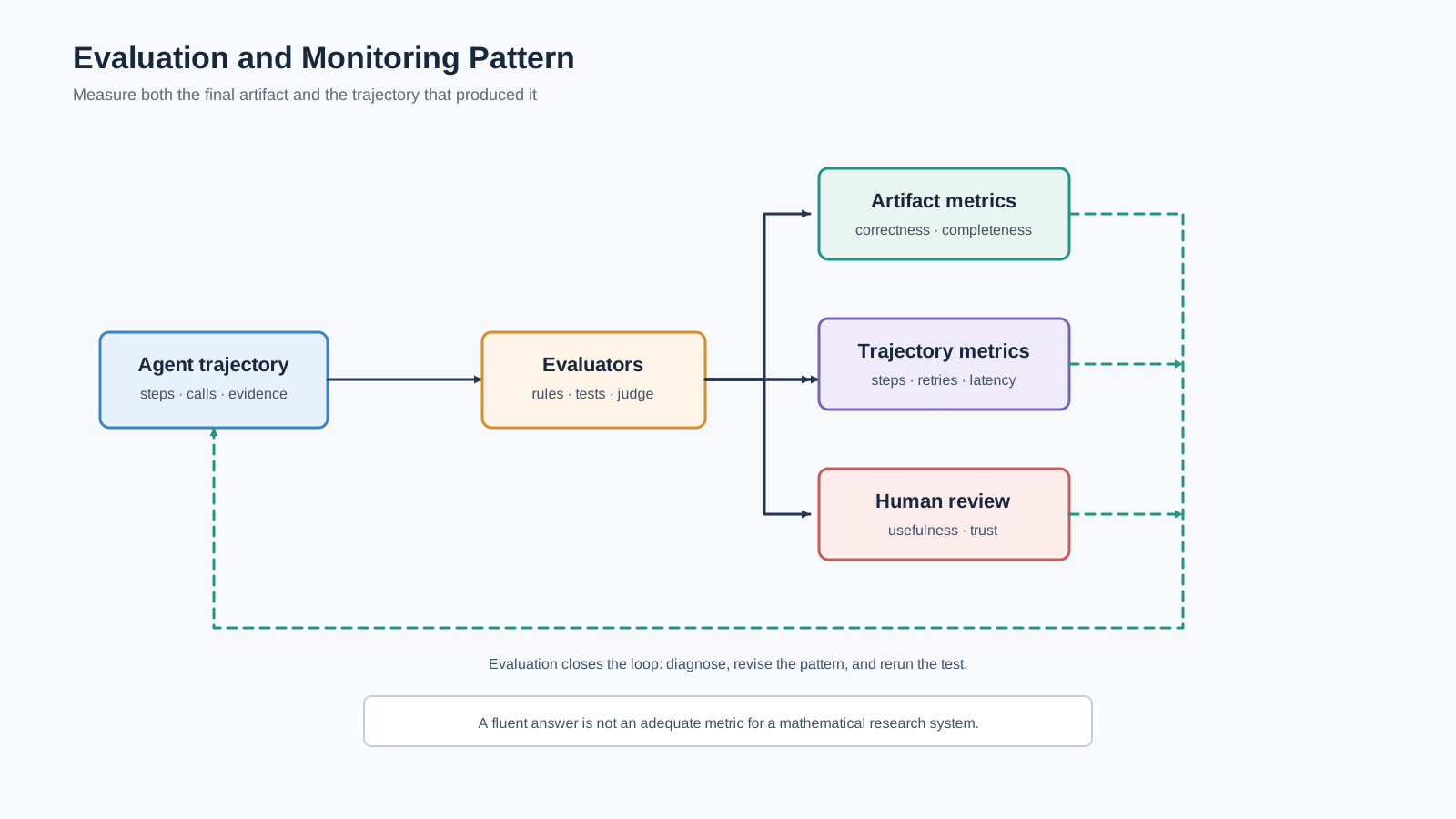
Figure: evaluators inspect both the final artifact and the trajectory that produced it.
In one sentence. A non-deterministic system cannot be unit-tested by string equality, so quality has to be made measurable by other means — a fixed test set, a judge, and metrics that describe the trajectory rather than the answer.
Problem
Fluent output is a weak proxy for task success. A system can produce attractive answers while retrieving irrelevant evidence, taking excessive steps, or silently violating a constraint.
Evaluation layers
- Artifact evaluation: correctness, completeness, format, and provenance.
- Trajectory evaluation: tool calls, intermediate artifacts, retries, latency, cost, and stopping decisions.
- System evaluation: reliability, safety, user usefulness, and behavior under degraded models, missing tools, or empty retrieval.
Mathematical metrics
Test hypothesis preservation, citation accuracy, proof-checker acceptance, counterexample detection, useful-gap detection, and reproducibility. Use deterministic tests where possible; use model judges or humans for criteria that cannot be formalized, and record their uncertainty.
Evaluation-driven development
The obstacle is stated most sharply as a question about testing: how do you write a unit test for a system whose output changes between runs? Asserting equality against an expected string fails constantly and tells you nothing.
The standard answer has two parts. A golden dataset of roughly fifty to a hundred representative inputs with their ideal outputs is run in the build pipeline, so that a prompt change or a model upgrade cannot silently break core behavior. Because nobody can review a hundred responses on every build, an LLM-as-judge scores each response against the golden answer on named criteria — accuracy, groundedness, tone — producing a quantity that can be tracked over time.
The judge is itself a component with failure modes, and treating its score as ground truth reintroduces the problem it was meant to solve. A judge sharing the generator’s model and prompt shares its blind spots; judges favor longer and more fluent answers independently of correctness; and a score without a named violated criterion tells an engineer nothing about what to repair. Use deterministic checks wherever the criterion can be formalized, reserve the judge for what cannot, and calibrate it against human labels on a sample rather than assuming agreement.
Build the golden set — ordinary cases, edge cases, and known failures — before optimizing prompts or architecture. Monitor drift after deployment and turn recurring failures into regression tests.
What to monitor in production
Conventional dashboards do not describe these systems. Alongside the usual service metrics, track cost per query and per user with alerts on spikes; time to first token and tokens per second at the tail rather than the mean; rate-limit and server-error rates per provider, since these are what the fallback logic consumes; judge scores over time; and the escalation rate — the fraction of tasks the system fails to resolve and hands to a human. The last is the most informative single number, because it moves when quality degrades for reasons no individual metric captures.
Real-world application
An automated report service should evaluate both the final report and the trace that produced it: source coverage, schema validity, latency, cost, and policy violations. A score without a retained artifact does not tell an engineer what to repair.
Exercises
- Build a ten-case golden set for one task: five ordinary, three edge, two known failures. Which of the ten can be checked deterministically?
- Write judging criteria for one of those cases. Have a judge score three responses, score them yourself, and measure the disagreement.
- Construct a case where the artifact is correct and the trajectory is bad (excessive retries, irrelevant retrieval, a skipped check). Which metric catches it?
- Your escalation rate rises from 4% to 9% with every other metric flat. List three causes and the evidence that would separate them.
- For a proof-checking agent, state which of the mathematical metrics above are deterministic and which need a judge, and justify the boundary.
Reference basis
The pattern follows Gulli, Agentic Design Patterns, Chapter 19, “Evaluation and Monitoring,” and Dibia, Designing Multi-Agent Systems, Chapter 10, “Evaluating Multi-Agent Systems.” Dibia’s emphasis on trajectory evaluation is especially relevant when the final answer alone hides a failed intermediate step. The golden-dataset and LLM-as-judge patterns, together with the production metrics above — cost per query, time to first token, provider error rates, and escalation rate — are the testability and observability patterns in Mitra, System Design for the LLM Era, Chapter 2. Judging is treated as a pattern in its own right, with its calibration problems, by Lakshmanan and Hapke, Generative AI Design Patterns, Pattern 17, alongside the degradation-testing pattern for behavior under a weakened model or a missing tool.