Agent Systems: Exception Handling and Recovery
Figure
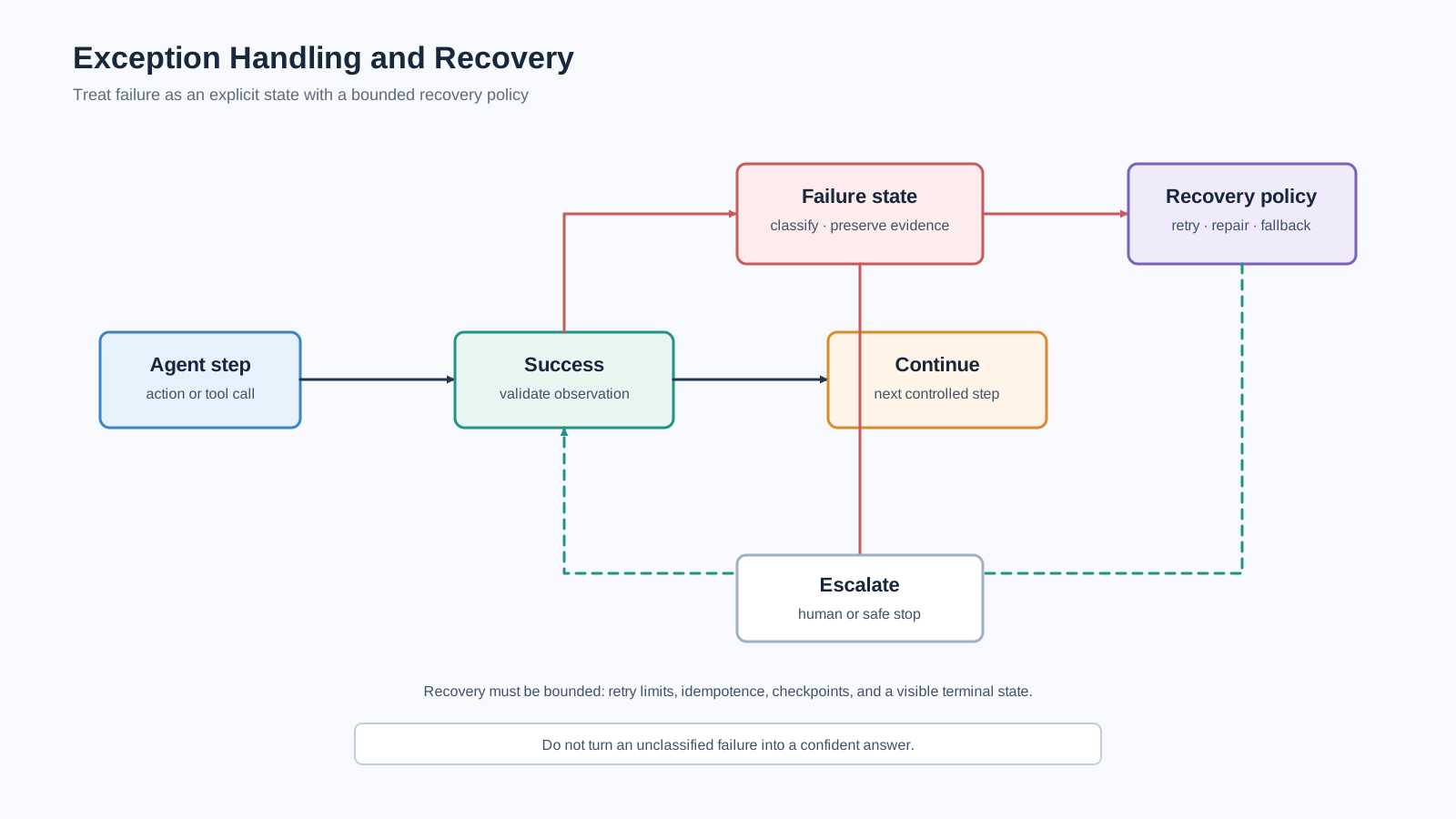
Figure: failures are classified and routed to bounded retry, repair, fallback, escalation, or safe stop.
In one sentence. Treat failure as state rather than as another prompt: classify it, retry only where retrying helps, and surface what cannot be repaired.
Problem
Tools fail, retrieval returns nothing, output violates a schema, services time out, and plans become invalid. Treating every failure as another prompt hides the actual state of the system.
Intent and structure
action → classify failure → retry / repair / fallback / escalate / stop
Classify failures as transient, structural, semantic, permission-related, or mathematical uncertainty. The category determines the recovery policy.
Recovery contract
Preserve the failed artifact, error, inputs, attempt count, and checkpoint. Retry only when the operation is safe and bounded. Repair malformed structure without silently changing content. Fall back to a simpler method only when its quality limits are explicit.
Mathematical rule
An unresolved gap is a valid terminal state. Never convert it into a successful- looking summary merely because a later generation step is fluent.
Forces and failure modes
Recovery improves availability but can amplify side effects, duplicate work, or loop forever. Use idempotence, exponential backoff where appropriate, retry limits, circuit breakers, and human escalation.
Real-world application
When a payment API, retriever, or code tool fails, the system should classify the failure before retrying. A bounded retry, an idempotent replay, a fallback, or a human escalation is safer than sending the same action again until the context window or budget is exhausted.
Reference basis
The pattern is Gulli, Agentic Design Patterns, Chapter 12, “Exception Handling and Recovery.” The production consequences of retries, fallbacks, and failure isolation are developed in Mitra, System Design for the LLM Era, Chapter 2, including the circuit-breaker and tiered-fallback patterns.