Agent Systems: Exploration and Discovery
Figure
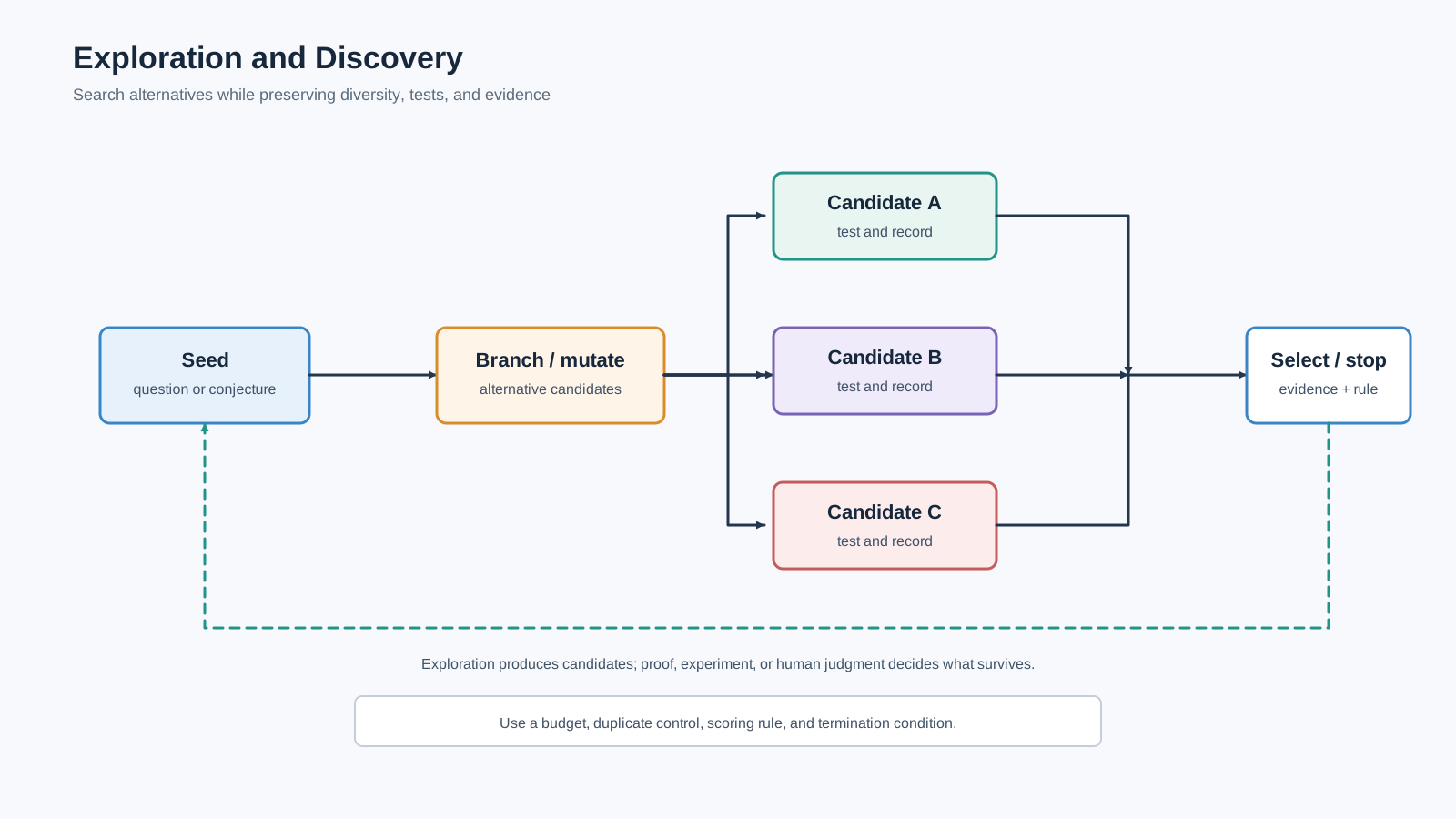
Figure: course redraw of the pattern. The architecture makes the candidate frontier, worker roles, evidence ledger, and termination gate explicit; it is not a reproduction of the book’s conceptual visual summary.
In one sentence. Search deliberately over candidates with an explicit test and a stopping rule; exploration produces evidence, never proof.
Problem
A single greedy line of reasoning can miss useful cases, counterexamples, or alternative proof strategies. Open-ended exploration can also spend resources without producing new information.
Intent and structure
seed → branch or mutate → test → retain evidence → select or stop
The candidate representation, test procedure, scoring rule, and termination condition must be explicit. Exploration is a search procedure; it is not itself proof.
Mathematical uses
Use the pattern to generate conjectures, search examples, compare proof strategies, or explore neighboring definitions. Candidate records should retain the assumptions tested, the computation or argument used, and the reason for retaining or discarding the candidate.
Forces and failure modes
Breadth improves discovery but creates combinatorial growth, duplicate candidates, and selection bias. Beam limits, diversity criteria, counterexample tests, budgets, and human review keep the process meaningful.
Design question
What new evidence justifies expanding the search, and what evidence justifies stopping it?
Real-world application
For product discovery or scientific search, several candidate explanations can be explored in parallel and tested against examples or counterexamples. The system should preserve discarded branches and apply a budgeted selection rule, so novelty does not replace evidence.
Reference basis
The source pattern is Antonio Gulli, Agentic Design Patterns, Chapter 21. The branch-evaluate-prune structure, with an explicit state evaluator and search budget, is Pattern 14 in Lakshmanan and Hapke, Generative AI Design Patterns, after Yao et al., Tree of Thoughts. The six-role decomposition in the figure follows the published description of Google Research’s AI co-scientist: Generation, Reflection, Ranking, Evolution, Proximity, and Meta-review coordinated by a Supervisor. For a research workflow that makes perspective discovery, source gathering, and outline curation concrete, compare the STORM paper.