Agent Systems: Terminology and Atomic Building Blocks
Figure
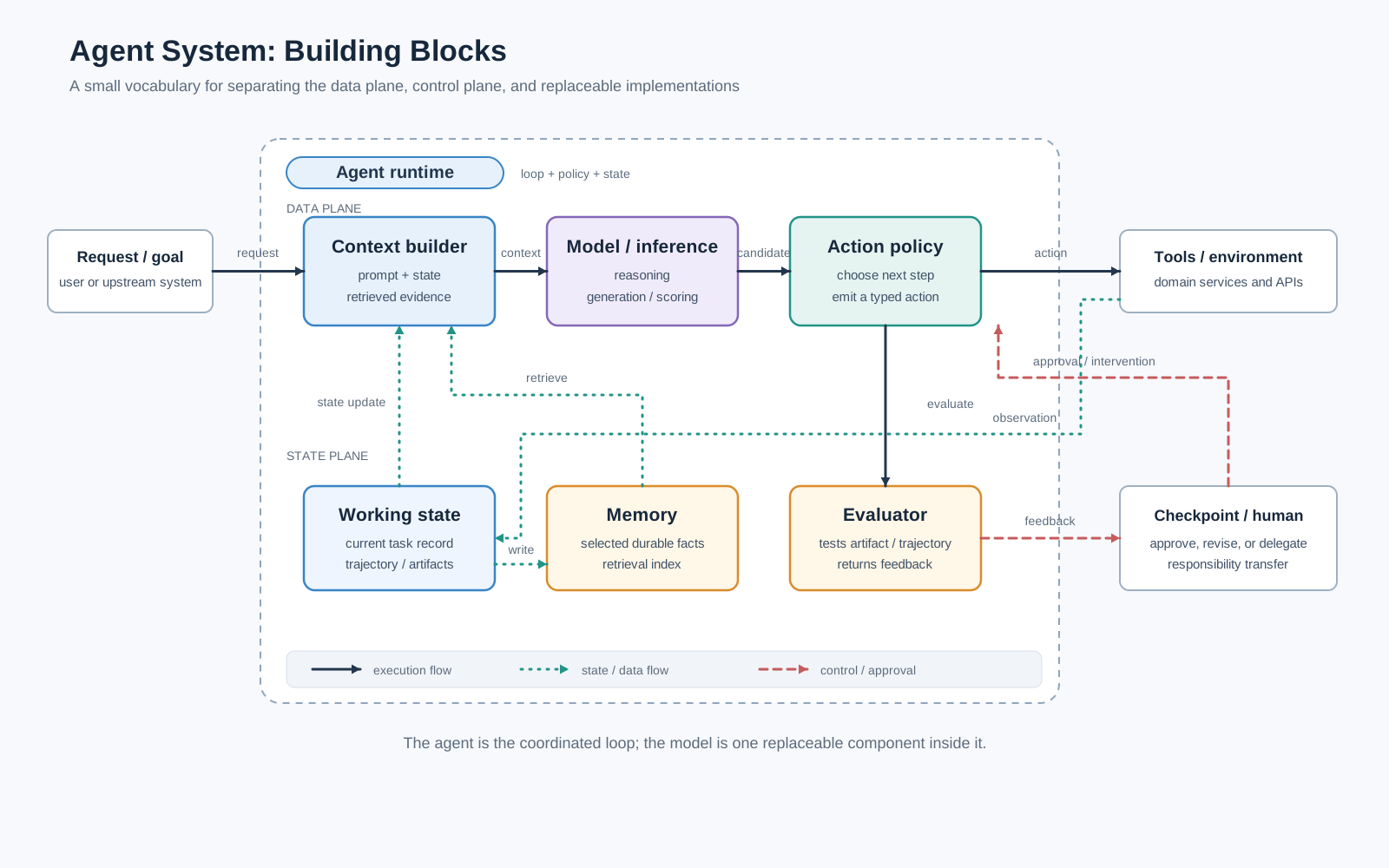
Figure: the basic objects and interfaces used throughout the series.
In one sentence. Fixing the words — model, agent, context, state, tool, memory, evaluator, checkpoint — so that later pages can argue about boundaries instead of about vocabulary.
This page fixes the vocabulary used by the rest of the course. The books use different names for similar components, but the design question is the same: which boundary should remain stable when the model or implementation changes?
The basic objects
- A model maps a prompt and context to a candidate output.
- An agent adds a loop, state, tools, and a policy for choosing the next action.
- Context is the bounded information supplied to one inference step.
- State is the information that persists between steps.
- A tool is an external capability with a callable interface and an observation returned to the agent.
- Memory stores selected past information for later retrieval.
- An evaluator tests an artifact or a trajectory against a criterion.
- A checkpoint transfers responsibility to a human or another component.
Pattern anatomy
For every pattern, identify the recurring problem, intent, participants, stable interface, variable implementation, forces, failure modes, and composition with other patterns. This prevents a framework feature from being mistaken for a design principle.
Atomic contract
input → context → inference → action → observation → state update
The contract is deliberately small. Structured artifacts, tool schemas, messages, state records, and evaluation reports are more important than a particular model name.
The prompt level
Below the pattern vocabulary sits a smaller one for a single inference, and it is worth fixing separately because patterns are often applied to problems that a better-specified call would have solved. Five principles cover it: give direction, so the model knows the role and the goal; specify format, so the output has a shape a downstream component can consume; provide examples, which constrain behavior more reliably than description; evaluate quality, so that “better” is measurable before anything is tuned; and divide labor, splitting a task into steps each of which can be checked.
The last is the hinge between the two levels. Dividing labor across separate inferences is where prompting ends and architecture begins, and every pattern in Part II is a disciplined way of doing it.
Design test
If replacing the model requires rewriting every downstream component, the system has exposed an implementation instead of an interface.
Real-world application
In a production request, these objects appear as concrete boundaries: an API request becomes bounded context, the model proposes an action, a tool returns an observation, and an evaluator or policy decides whether state may change. The building blocks are useful because each boundary can be logged and tested independently.
Reference diagrams and sources
The vocabulary is anchored in Gulli, Agentic Design Patterns, the introduction and Chapter 1, and Dibia, Designing Multi-Agent Systems, Chapter 4. This figure is an original teaching redraw: it synthesizes the vocabulary of the four course books rather than reproducing one of their illustrations. Its main loop can be compared with Figure 1 of Yao et al., ReAct: Synergizing Reasoning and Acting in Language Models, where reasoning steps and external actions are interleaved through observations: paper and Google Research overview.
For the surrounding component vocabulary and orchestration boundaries, see Victor Dibia’s official Designing Multi-Agent Systems book site. The five prompt-level principles — give direction, specify format, provide examples, evaluate quality, divide labor — are Chapter 1 of James Phoenix and Mike Taylor, Prompt Engineering for Generative AI, O’Reilly, first edition, May 2024, ISBN 978-1-098-15343-4. The broader pattern catalogues are linked directly above and in the reference basis at the end of each pattern page.