Agent Systems: Human-in-the-Loop Pattern
Figure
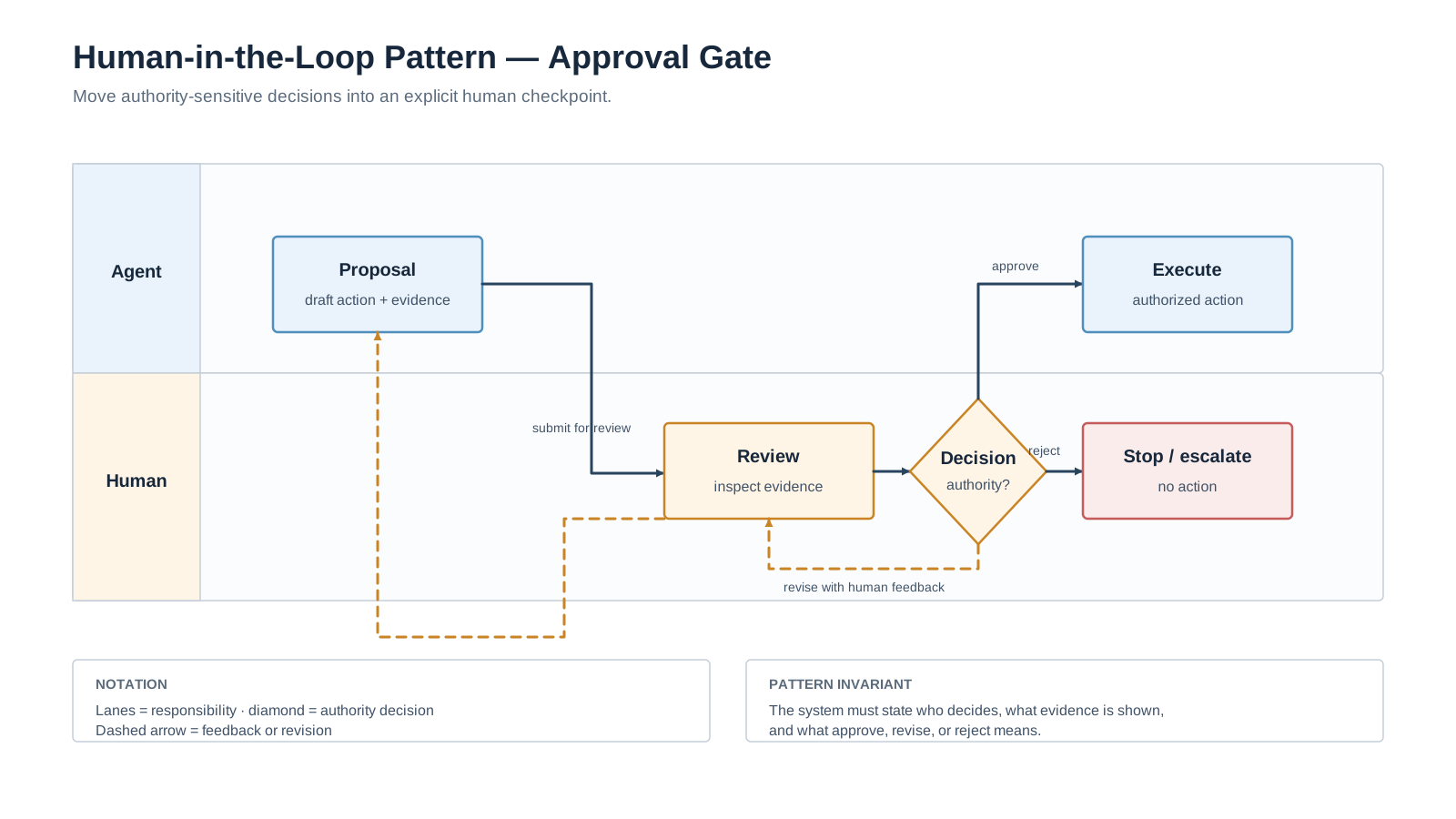
Figure: the system pauses at an explicit checkpoint when human judgment is required.
In one sentence. Place a person at the decisions that are irreversible or beyond an evaluator, and make the handover an interface rather than an interruption.
Problem
Some decisions are high impact, ambiguous, irreversible, or not captured by an automated evaluator. Full autonomy would hide responsibility rather than remove the decision.
Intent and structure
agent work → checkpoint → human review or correction → resume, revise, or stop
A checkpoint should present the artifact, evidence, uncertainty, available choices, and consequences. “Human approval” is not useful if the reviewer cannot see what is being approved.
Where to place checkpoints
Use them before irreversible tool actions, after ambiguous routing, when a quality evaluator disagrees, when the budget or stopping condition is reached, or when a result is ready for publication. Routine low-risk work can remain automated.
Forces and failure modes
Human review improves accountability and handles open-ended judgment, but it adds latency and can become a rubber stamp. Escalate selectively, explain why, record the decision, and make resumption idempotent.
Mathematical example
The system may propose a proof direction or a literature connection, while the mathematician decides whether it is relevant, novel, or worth pursuing.
Real-world application
Refunds, access changes, publication decisions, and other consequential actions need an explicit approval checkpoint. The agent should present the proposed action, evidence, uncertainty, and reversible alternatives, then resume from a durable checkpoint after the human accepts or rejects it.
Reference basis
This follows Gulli, Agentic Design Patterns, Chapter 13, and Dibia, Designing Multi-Agent Systems, Chapter 4, Section 4.13, “Adding Humans in the Loop.” For a current engineering discussion of human control, transparency, and agent risk, see Anthropic’s Trustworthy agents in practice.