Agent Systems: Learning and Adaptation
Figure
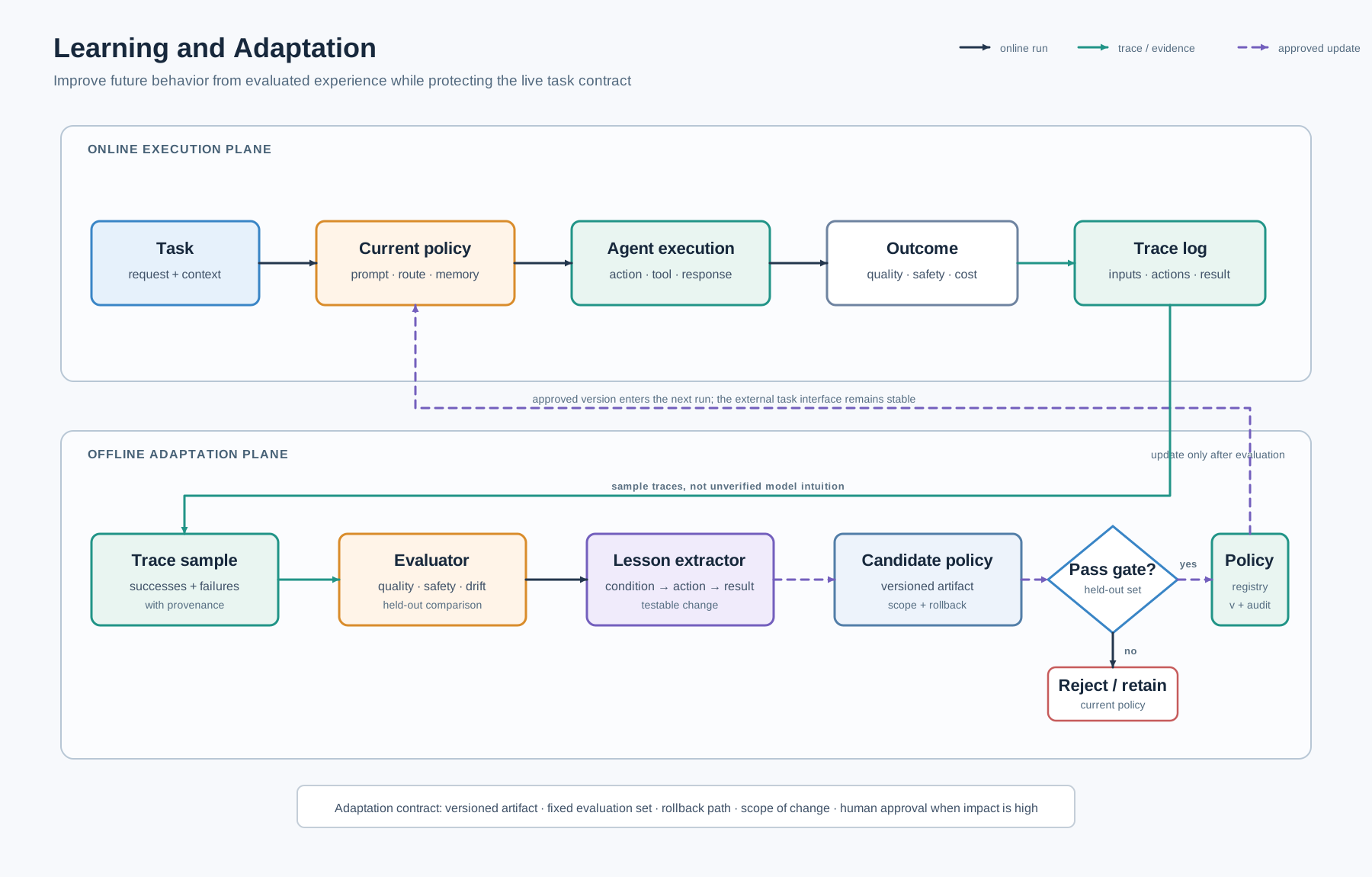
Figure: course architecture redraw. Online traces feed an offline adaptation plane; only a candidate that passes held-out evaluation enters the versioned policy registry.
In one sentence. Turn outcomes into changes of prompt, policy, or examples — slowly enough not to erase behavior that was already working.
Problem
An agent that repeats the same failed strategy wastes resources. Yet changing the policy after every outcome can cause instability and erase useful behavior.
Intent and structure
trajectory → evaluate → extract lesson → update policy or memory → test again
Adaptation can modify prompts, routing rules, retrieval indexes, tool selection, memory, or a model. Keep the learned artifact separate from the run that produced it and make its scope explicit.
What counts as a lesson?
A useful lesson identifies the task condition, the attempted action, the result, and the evidence that a different action is preferable. A failed proof attempt may suggest a new decomposition; it does not establish that the alternative is correct.
Forces and failure modes
Adaptation improves performance on recurring tasks but risks overfitting, catastrophic forgetting, and self-reinforcing errors. Use held-out evaluation cases, rollback, versioned policies, and human approval for high-impact changes.
Real-world application
A support router can learn from resolved tickets, but only after feedback is validated and evaluated against a fixed test set. Versioned prompts, routing policies, and memories let the team roll back a change that improves one queue while damaging another.
Reference basis
This page follows Antonio Gulli, Agentic Design Patterns, Chapter 9, “Learning and Adaptation.” Dibia’s evaluation and optimization treatment provides a complementary systems perspective. The online/offline separation, rollback, and fixed-evaluation requirements are course engineering safeguards, not a claim that online learning is automatically safe.