Case Study: Danus and Rethlas
Figure 1
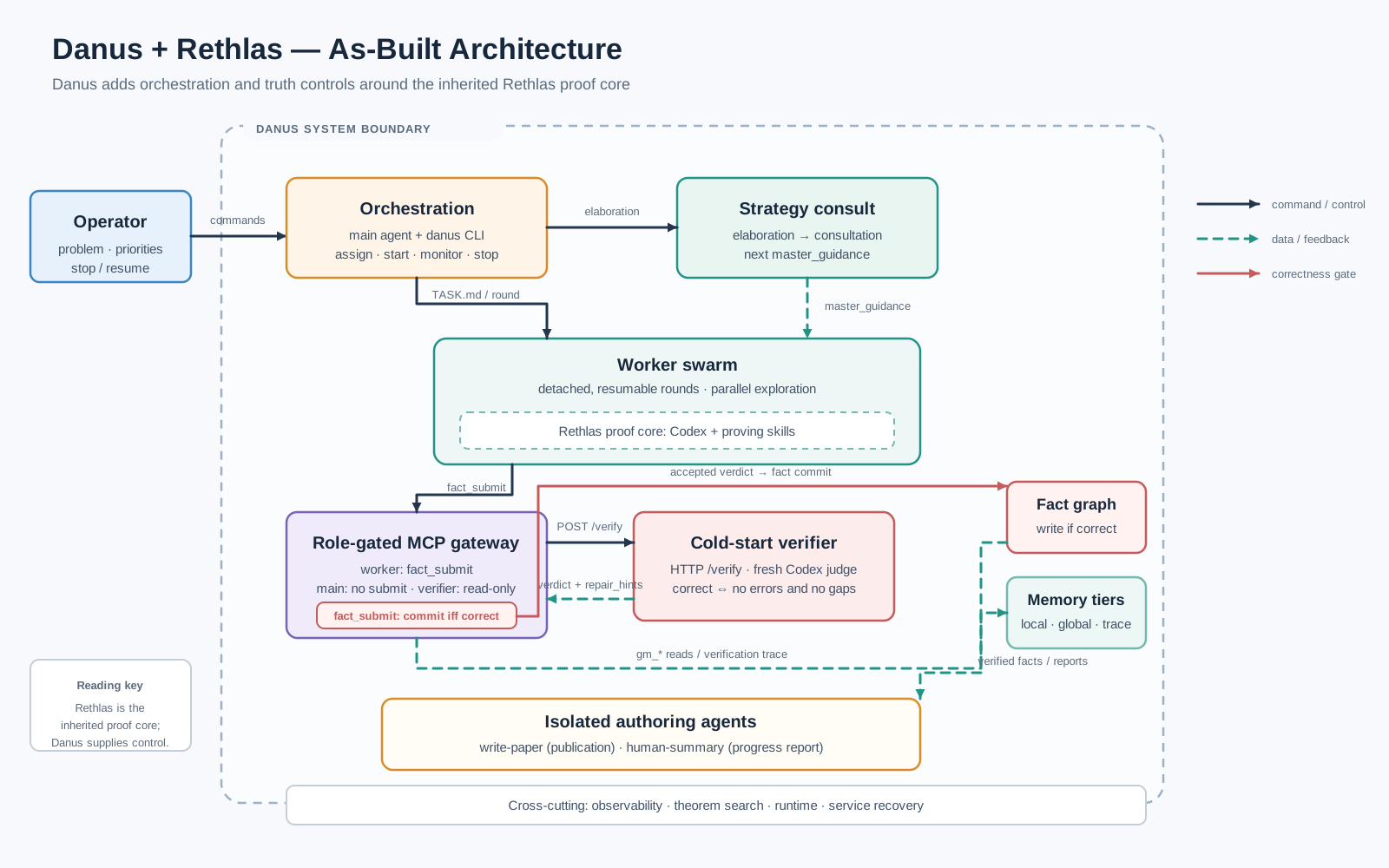
Figure 1. A layered as-built view of the case study. Solid navy arrows show control, dashed teal arrows show data or feedback, and red arrows mark the correctness-gated path into the fact graph. The dashed teal return carries the verifier’s verdict and repair hints back to the gateway; the gateway’s fact_submit path contains the write gate, and only verdict == "correct" leaves on the red commit path into the fact graph.
In one sentence. Two real codebases read as an as-built pattern map: what the books call reflection, tool use, and evaluation appear here as concrete modules around one correctness boundary.
This case study uses two real codebases. Rethlas is the smaller proof-search system: a generation agent reads a mathematical problem and drafts a proof blueprint, while a verification agent checks the blueprint through a local HTTP service. Danus builds a long-running, strategy-steered worker system on top of that generation–verification core.
The architecture is a code-based case study. Its purpose is to show how the patterns from the reference books appear as concrete modules and interfaces. For the proposed strategy layer that recommends proof methods and compiles critic-tested obligation graphs, see the proof-sketch and method-recommendation system. Its domain-specific specialization is the birational-geometry research architecture.
Rethlas: the two-agent core
The Rethlas repository separates proof generation from proof verification.
- A problem is stored as Markdown under the generation agent’s data directory.
- The generation agent uses explicit tools for theorem search, memory, branch state, and proof verification.
- It produces a Markdown proof blueprint rather than treating a fluent answer as a finished proof.
- The verification service exposes
/verify; it starts a fresh verification agent and expects a structured JSON verdict. - A rejected blueprint returns repair hints; the generation agent revises and submits again.
- A successful run produces
blueprint_verified.md.
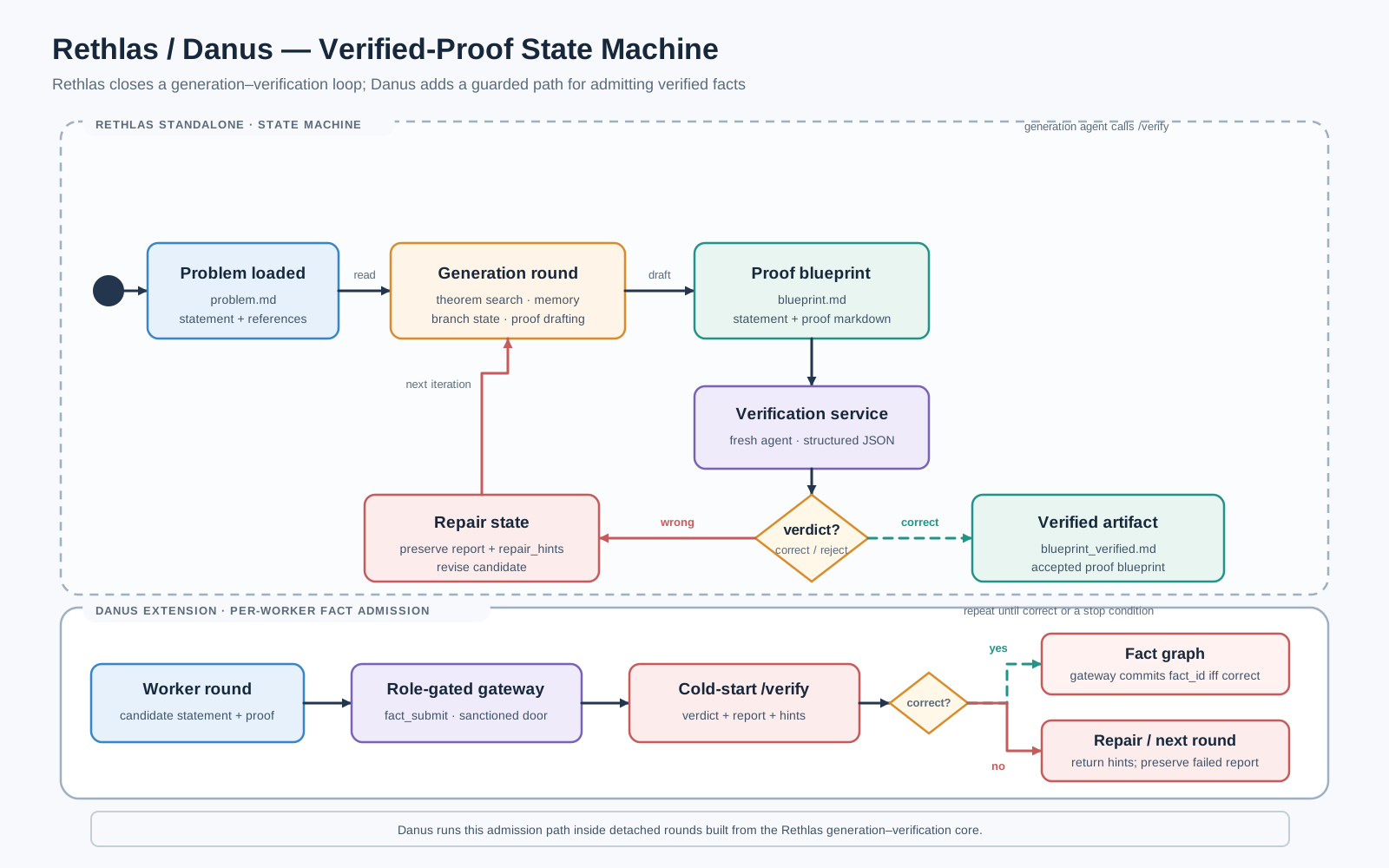
Figure 2. The upper state machine is the standalone Rethlas loop. The lower flow is Danus’s per-worker fact-admission path, where fact_submit reaches the verifier before a fact can be committed.
This is a direct instance of the books’ reflection, tool-use, exception-recovery, structured-output, and human-or-machine evaluation patterns.
Danus: extending the core
Danus adds the system architecture needed for multiple problems, workers, and long-running operation:
- Orchestration: the main agent and the
danusCLI create projects, assign tasks, start workers, inspect status, and stop execution. The orchestrator coordinates work; it is not the correctness authority. - Strategy: an elaboration is prepared, a strategy consultation is run, and the resulting
master_guidancesteers the next worker round. - Execution: detached workers run rounds, each using the inherited Rethlas proving skills. Multiple workers provide parallel exploration.
- Verification: a cold-start verifier judges submitted statements and proofs. The verdict is strict: a result is correct only when there are no critical errors and no gaps.
- Truth and memory: worker-local memory, project-global memory, and a content-addressed fact graph have different roles. Only verifier-accepted facts enter the fact graph.
- Gateway: the role-gated MCP gateway controls the tool surface. Workers can submit facts; the main agent cannot call
fact_submit; the verifier is read-only. - Outputs: isolated authoring agents render verified material into a paper or a human progress summary.
- Operations: theorem search, observability, loopback services, configuration, and recovery scripts support the runtime without becoming sources of truth.
Pattern mapping
| Book pattern | Concrete realization in Danus/Rethlas |
|---|---|
| Prompt chaining | staged problem reading, proof drafting, verification, and repair |
| Routing and planning | main-agent task assignment and strategy guidance |
| Parallelization | detached worker swarm exploring different proof directions |
| Reflection | verifier feedback and generation-agent repair loop |
| Tool use | MCP tools, theorem search, and the /verify HTTP interface |
| Structured output | proof Markdown, verification JSON, memory channels, and fact records |
| Memory management | worker-local logs, global findings, and verified facts |
| Multi-agent cooperation | operator, main agent, workers, verifier, and isolated authoring agents |
| Exception recovery | retry, repair hints, persisted rounds, and explicit failure states |
| Evaluation and guardrails | strict verdict schema, role permissions, and the fact write-gate |
| Resource-aware operation | configurable workers, models, transports, service timeouts, and detached execution |
Design lessons
- The most important pattern is the correctness boundary: generation may be broad and exploratory, but truth is introduced only through verification.
- The interface boundary matters more than the agent’s label. MCP tool schemas, the
/verifyrequest, the verification JSON, and fact identifiers make components replaceable. - The workflow/autonomy distinction is visible in the architecture. Rethlas is a bounded two-agent loop; Danus adds autonomous workers but keeps them inside explicit round, memory, permission, and termination controls.
- The system demonstrates why design patterns are useful for mathematical software: they separate search, judgment, storage, and publication so that each can be inspected independently.
Scope and limits
This page documents the architecture visible in the local Danus and Rethlas code snapshots used for this case study. The linked papers and repositories provide public provenance, but their default branches or later revisions may differ from the snapshots inspected here. It does not claim that either system automatically proves arbitrary mathematics. A verified artifact is a result accepted by the system’s verifier contract; mathematical interpretation and research significance remain separate questions.
How to read the diagrams
The two diagrams deliberately use different forms: the first emphasizes components and boundaries, while the second emphasizes states, decisions, and recovery. Both describe the same code-based case study.
References
- J. Liu et al., “Danus: Orchestrating Mathematical Reasoning Agents with Fact-Graph Memory,” arXiv:2607.06447 (2026). Paper and source repository.
- H. Ju et al., “Automated Conjecture Resolution with Formal Verification,” arXiv:2604.03789 (2026). Paper and Rethlas source repository.
- A. Gullí, Agentic Design Patterns: A Hands-On Guide to Building Intelligent Systems, Springer, 2025. Publisher record.
- V. Dibia, Designing Multi-Agent Systems: Principles, Patterns and Implementation for AI Agents. Author’s book site.