Agent Systems: Memory Management Pattern
Figure
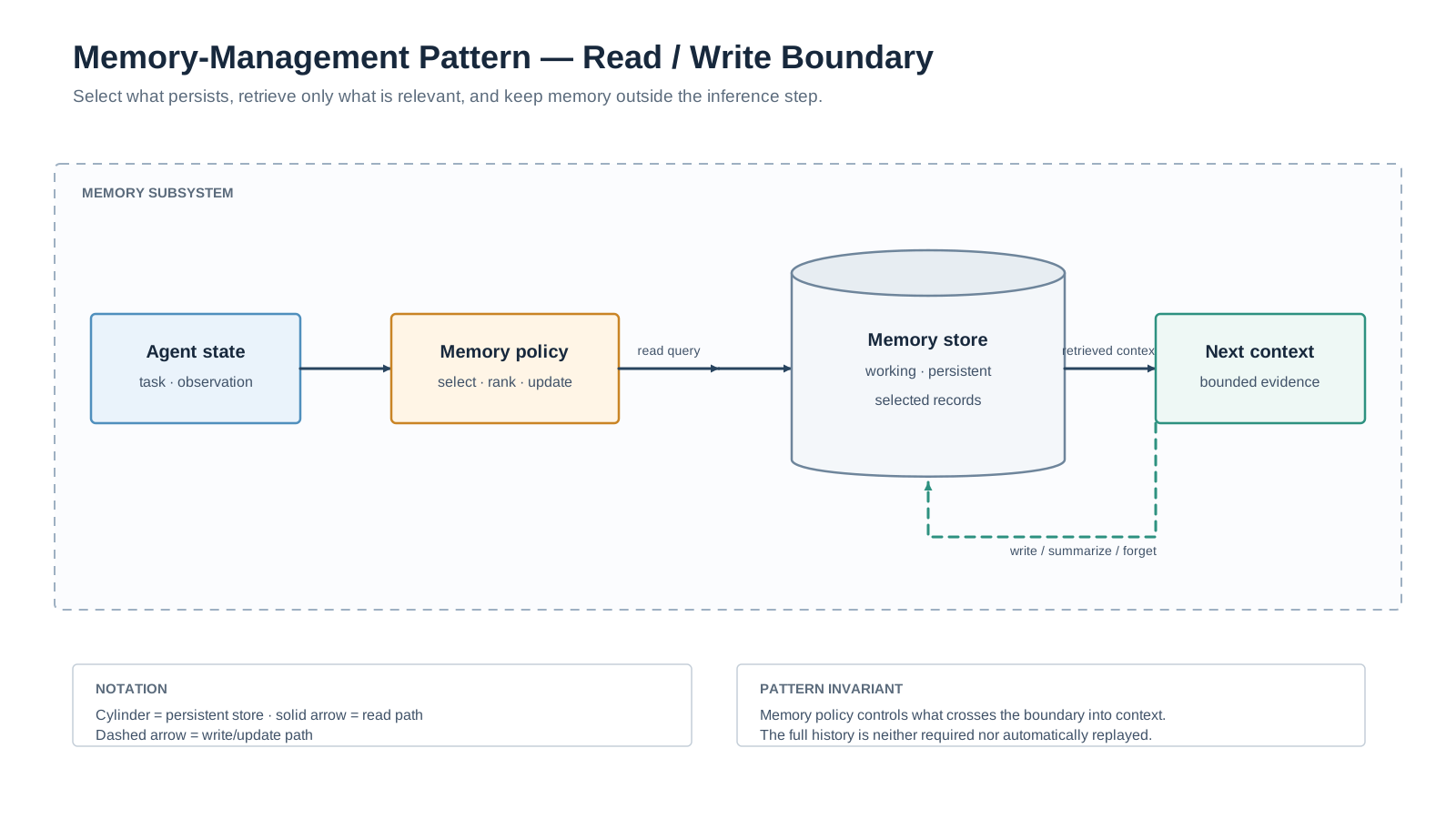
Figure: bounded working context is written to and recovered from longer-term memory.
In one sentence. Decide what survives beyond the current task and under what policy; storing every message is not a design.
Problem
Context windows are bounded, while tasks and histories are not. Copying every past message into every step increases noise, cost, and the chance of retrieving an obsolete instruction.
Intent and structure
experience → select → store → retrieve → current context
The books distinguish short-term working context from long-term memory and from external knowledge retrieval. A memory item needs content, scope, metadata, provenance, and a retrieval policy.
Memory is the persistence question: what survives beyond this task, and under what policy. It is distinct from deciding what enters a particular inference window, which is treated separately under context engineering. The two meet at retrieval — memory decides what may be recalled, context engineering decides what is actually admitted and at what priority.
Memory operations
Write only information that may be useful later; retrieve by the current task; compress or summarize under a stated policy; and expire or revise stale items. Memory should preserve failed paths when those failures prevent repeated work.
Mathematical design
Separate definitions and verified results from conjectures, heuristics, and scratch reasoning. A retrieved lemma must still be checked against the current hypotheses. Memory improves continuity; it is not a correctness certificate.
Forces and failure modes
More memory improves recall but increases context pollution and retrieval bias. Use scopes, provenance, ranking, limits, and explicit invalidation. Test whether the system performs better with a memory item rather than assuming persistence is always helpful.
Real-world application
In case management, short-term conversation state and durable customer records have different retention and access rules. A memory policy should decide what to write, how to retrieve it, how to expire it, and how to correct a stale record; storing every message is not a design.
Reference basis
The pattern is Gulli, Agentic Design Patterns, Chapter 8, and Dibia, Designing Multi-Agent Systems, Chapter 4, Sections 4.7 and 4.8, which distinguish application-managed retrieval from agent-managed memory in which the agent explicitly creates and deletes its own records. Long-term memory is Pattern 28 in Lakshmanan and Hapke, Generative AI Design Patterns. The treatment of a bounded window as a managed resource with paging between tiers, by analogy with virtual memory, is Packer et al., MemGPT: Towards LLMs as Operating Systems.