Agent Systems: Parallelization Pattern
Figure
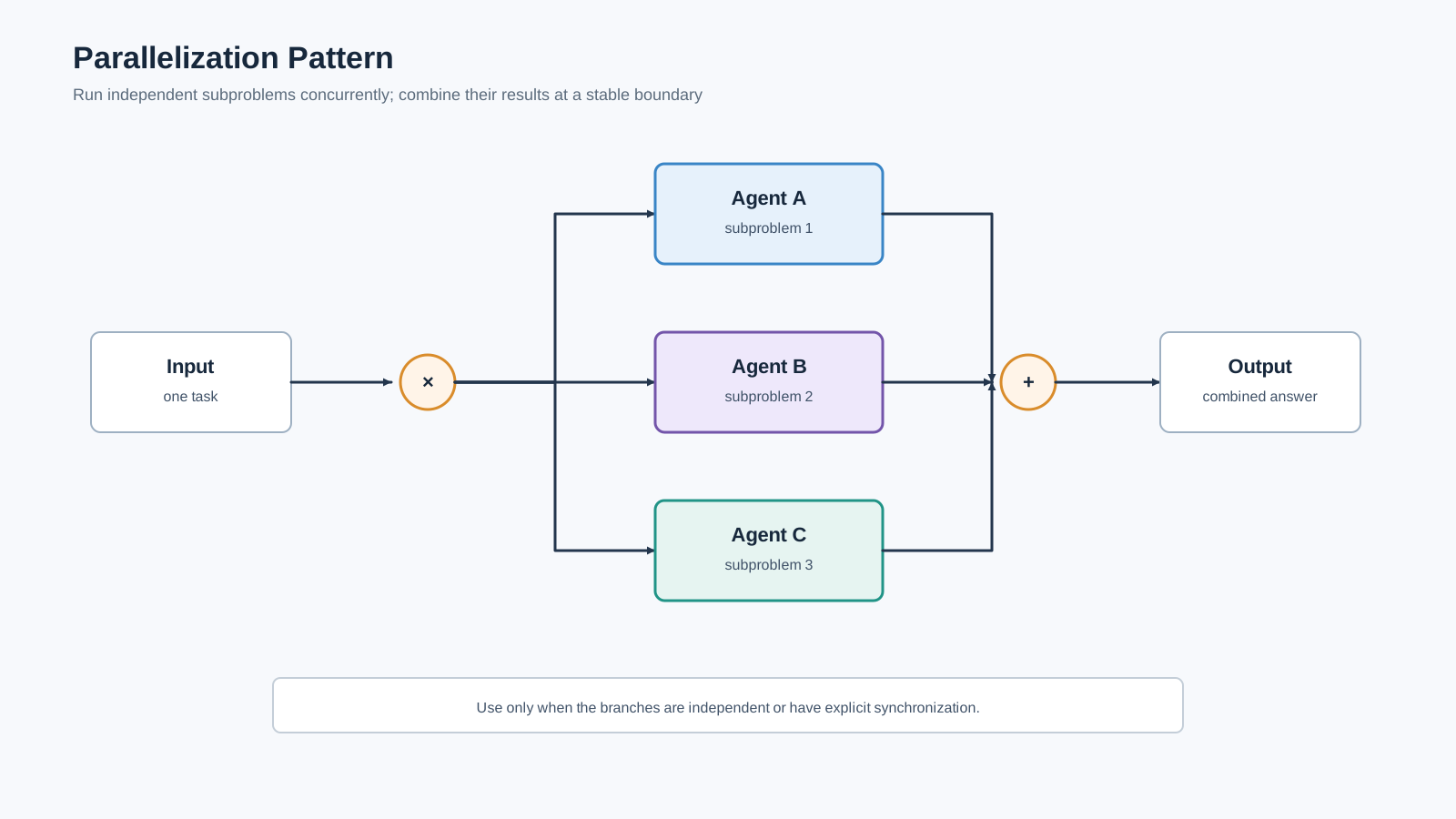
Figure: independent branches run concurrently and are combined by an aggregation step.
In one sentence. Run genuinely independent branches at once and aggregate deliberately; the hard part is the aggregation rule, not the concurrency.
Problem
Some tasks contain independent branches, but a sequential agent wastes latency and may become anchored to its first idea.
Intent and structure
shared input → independent branches → aggregation → evaluation
Branches may use different prompts, models, representations, or search directions. The aggregator compares outputs instead of merely concatenating them.
Mathematical example
For a difficult conjecture, one branch can search for counterexamples, another can try a direct proof, and another can look for a reduction to a known result. Each branch should return assumptions, claims, evidence, and unresolved gaps.
Forces and failure modes
Parallelization improves coverage and latency when work is independent, but it increases cost, duplicate work, and aggregation difficulty. Shared mutable state can create race conditions; use immutable artifacts or explicit ownership. The aggregator needs a quality rule, not just a majority vote.
Design test
Would the branches still be correct if they were run in a different order or on different machines?
Real-world application
In due-diligence or incident analysis, independent workers can inspect separate repositories, logs, or source collections at the same time. Aggregation is safe only after each branch returns a typed result with provenance and an explicit failure status.
Reference basis
This is Gulli, Agentic Design Patterns, Chapter 3, combined with Dibia, Designing Multi-Agent Systems, Chapters 2 and 6. Anthropic distinguishes sectioning and voting forms of the pattern in Building effective agents and warns that shared mutable state requires an explicit conflict policy.