Agent Systems: Plan-and-Execute Pattern
Figure
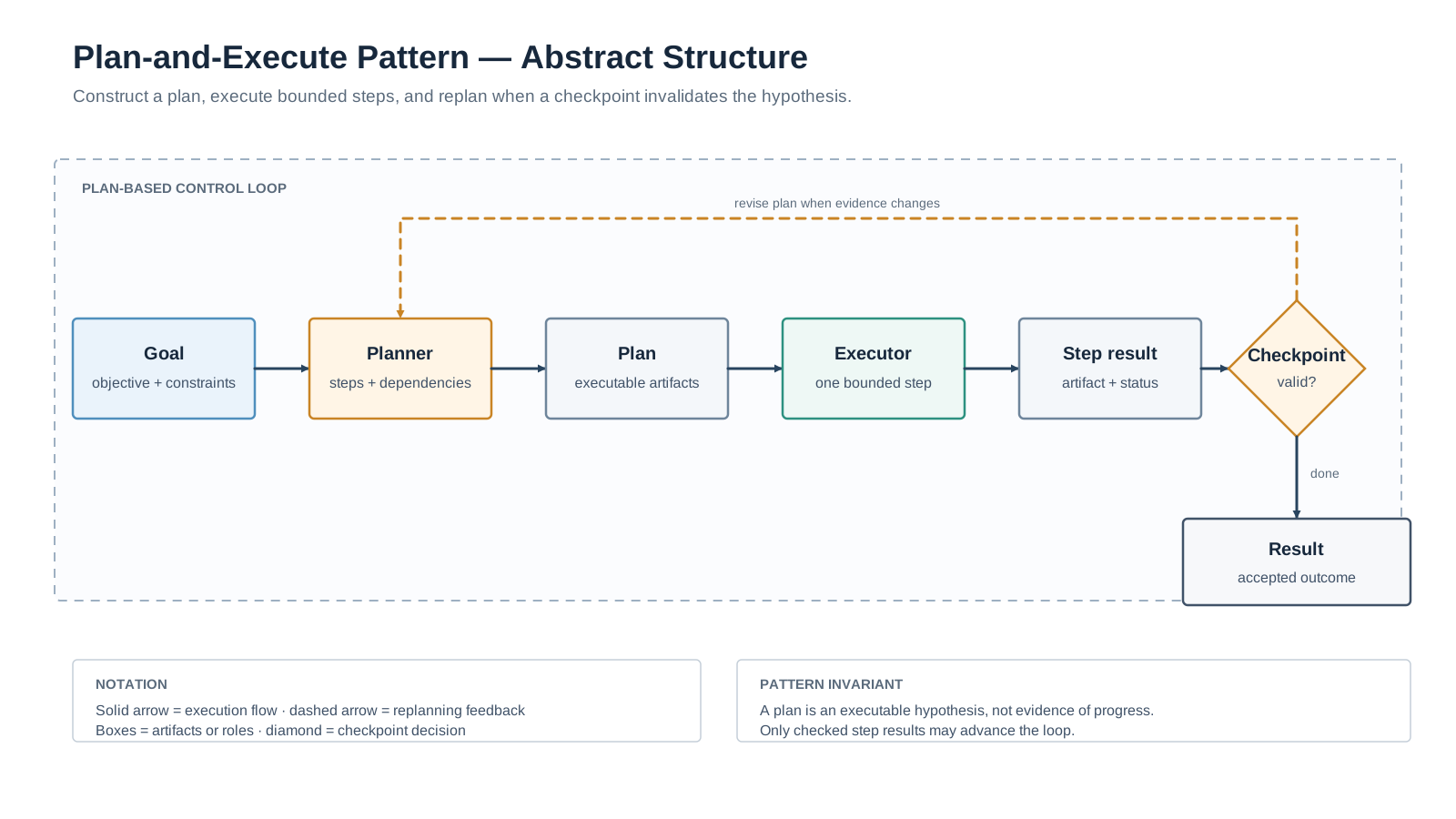
Figure: planning separates high-level decomposition from execution and revision.
In one sentence. Make the plan an artifact, so progress, dependencies, and replanning are visible instead of buried inside one long generation.
Problem
Long-horizon tasks fail when the agent treats the whole objective as one undifferentiated generation step. Dependencies and progress become invisible.
Intent and structure
goal → plan → execute step → checkpoint → revise or continue
The planner decomposes the goal; the executor performs one bounded step; an evaluator decides whether the plan remains valid. Planning and execution may use different models or systems.
Stable interface
Each step needs an identifier, preconditions, expected artifact, status, and verification result. A plan is not evidence of progress until its artifacts exist and have been checked.
Mathematical example
A proof search plan might separate notation, prerequisite lemmas, candidate constructions, and final assembly. If a prerequisite fails, revise the plan instead of continuing to execute obsolete steps.
Forces and failure modes
Planning improves coordination and resumability, but plans can be stale, overly detailed, or prematurely committed. Persist checkpoints, permit replanning, and define a stopping rule before expensive execution.
Real-world application
A software maintenance agent can turn an issue into a bounded plan, execute the steps in a sandbox, run tests, and send the diff for review. The plan is useful because the system can resume or repair one failed step without repeating the whole task blindly.
Reference basis
The planning pattern is Gulli, Agentic Design Patterns, Chapter 6. Dibia discusses explicit and implicit planning in Designing Multi-Agent Systems, Chapter 5, and persistent workflow execution in Chapter 6. A published architecture with planning, progress ledgers, and re-planning is documented in the Magentic-One technical report.