Agent Systems: Production Architecture
Figure
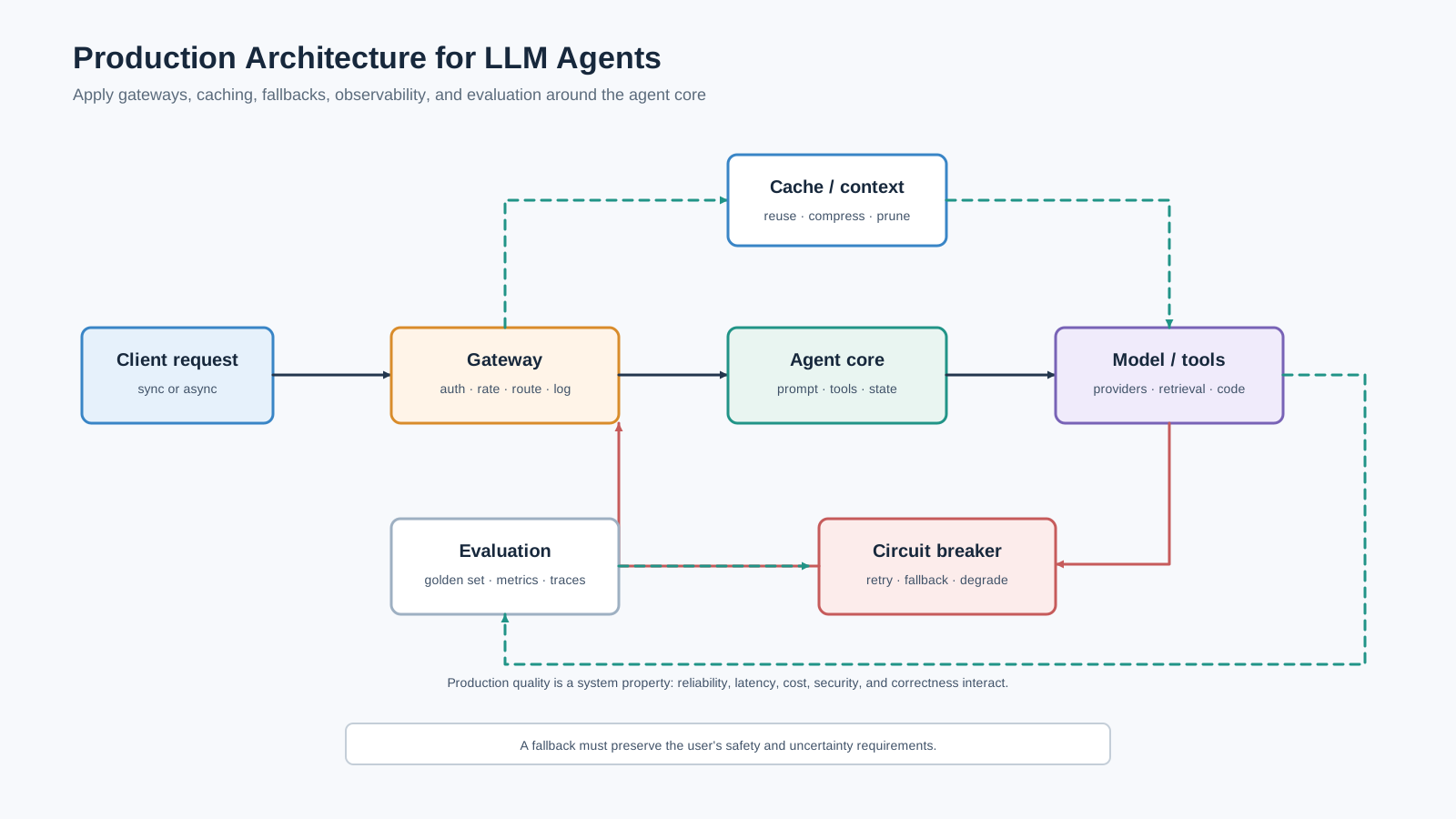
Figure: gateways, caching, fallbacks, and evaluation surround the agent core.
In one sentence. The whole request path — gateway, cache, fallback, observability — decides reliability; the model call is a small part of it.
Problem
An agent prototype may work in a notebook but fail under load, provider errors, long latency, changing prompts, or partial tool availability. Production design must control the whole request path, not only the model call.
Architecture
client → gateway → agent core → model/tools
Around this path, add authentication and rate limits, caching and context compression, synchronous or asynchronous execution, circuit breakers, tiered fallbacks, traces, and evaluation. The gateway is a policy boundary; it should not become a second source of truth.
Reliability patterns
- Circuit breaker: stop repeatedly calling a failing provider.
- Tiered fallback: move to a cheaper or simpler method with explicit quality limits.
- Checkpointing: persist a long-running task so it can resume after failure.
- Degradation testing: measure behavior when models, retrieval, or tools are unavailable.
Data and evaluation
Use stable request IDs, version prompts and schemas, record latency/cost/error metrics, and maintain a golden evaluation set. Cache only when the cache key captures all state that affects correctness.
Mathematical caution
A fallback that returns a shorter answer must not claim the quality of a verified proof. Degraded operation should expose reduced confidence, reduced scope, or a human escalation.
Real-world application
For a customer-facing agent, the gateway owns authentication, rate limits, and request identity; the runtime owns task state; and the evaluator owns quality signals. Keeping those responsibilities separate makes provider failures, prompt changes, and partial tool outages observable in production.
Reference basis
The production patterns follow Mitra, System Design for the LLM Era, Chapters 2–6, especially gateways, circuit breakers, asynchronous processing, caching, evaluation, and security. Dibia’s Designing Multi-Agent Systems, Chapters 10–13 provide complementary references for trajectory evaluation, optimization, distributed protocols, and responsible deployment.
Reference architecture
This is a course synthesis of production concerns, not a copy of a vendor reference architecture. For the production-design viewpoint used here, see Sampriti Mitra’s System Design for the LLM Era.