Agent Systems: Prompt Chaining Pattern
Figure
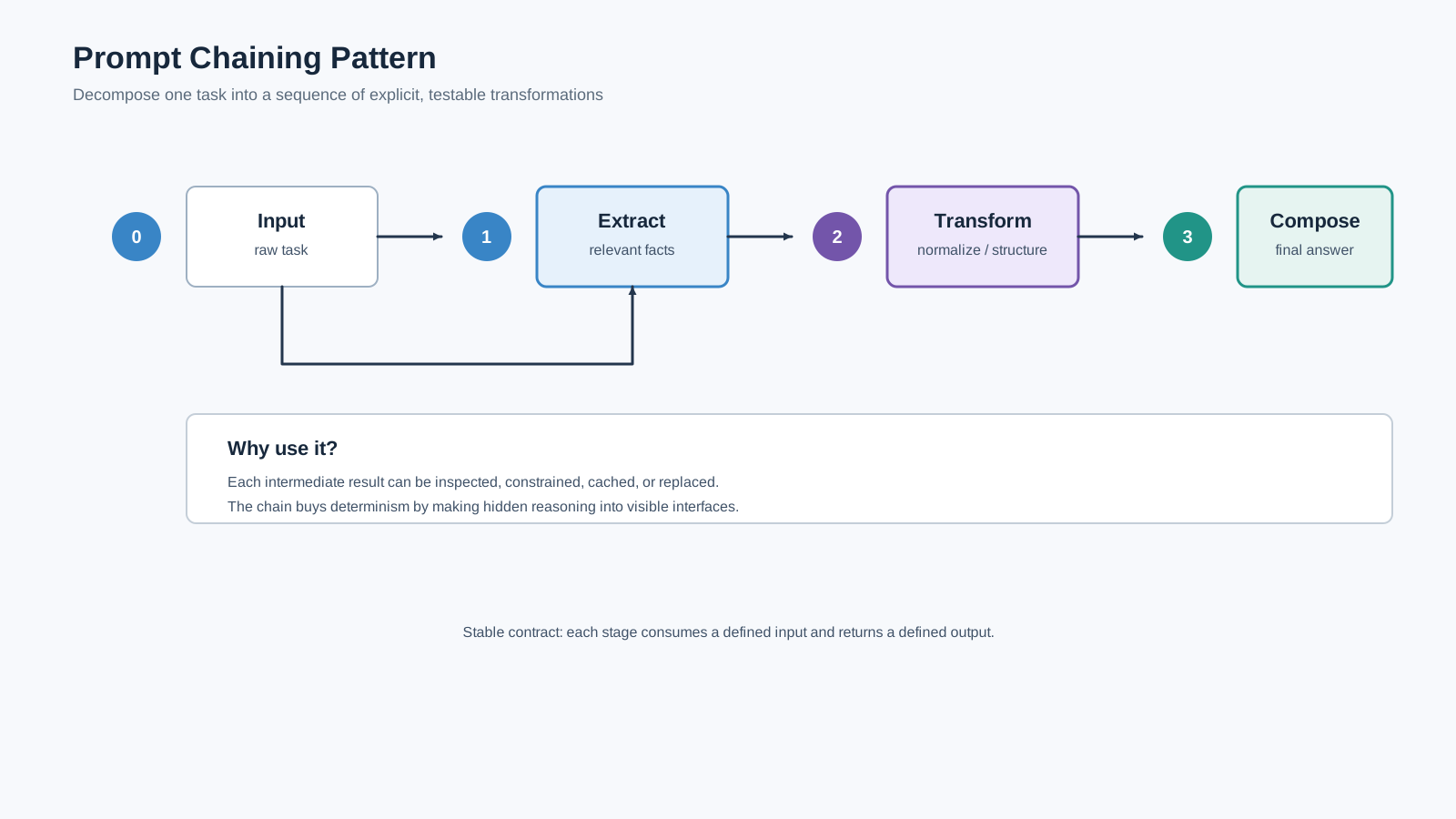
Figure: specialized stages pass structured artifacts forward.
In one sentence. Split one overloaded prompt into stages so each has a checkable output, paying latency and the risk that an early error propagates.
Problem
A single prompt must often perform incompatible jobs: interpret an input, extract structure, reason, verify, and format a deliverable. The result is hard to inspect and difficult to repair.
Intent and structure
Prompt chaining divides the task into ordered stages:
input → extraction → transformation → checking → presentation
Each stage has a narrower responsibility and passes an intermediate artifact to the next stage. The chain can use one model or different models.
Stable interface
The interface is the intermediate artifact: its schema, required fields, provenance, and error status. Natural-language instructions are implementation details around that contract.
When it helps
Use chaining when stages have clear dependencies, when intermediate errors need to be localized, or when different stages require different models or tools. A mathematical example is paper → metadata → theorem statement → proof skeleton → checked exposition.
Forces and failure modes
Chaining improves observability and revision, but adds latency and can propagate an early extraction error through every later stage. Validate high-value artifacts before continuing; formatting success is not mathematical correctness.
Real-world application
In an invoice or compliance workflow, one stage extracts fields, another checks them against policy, and a final stage prepares a human-readable report. Each stage can be replayed from its artifact when a supplier changes a field or the policy is revised.
Reference basis
This pattern follows Gulli, Agentic Design Patterns, Chapter 1, and Dibia, Designing Multi-Agent Systems, the explicit workflow treatment in Chapters 2 and 6. Anthropic gives an independent engineering description of prompt chaining and its intermediate gates in Building effective agents.