Agent Systems: Reasoning and Representation Change
Figure
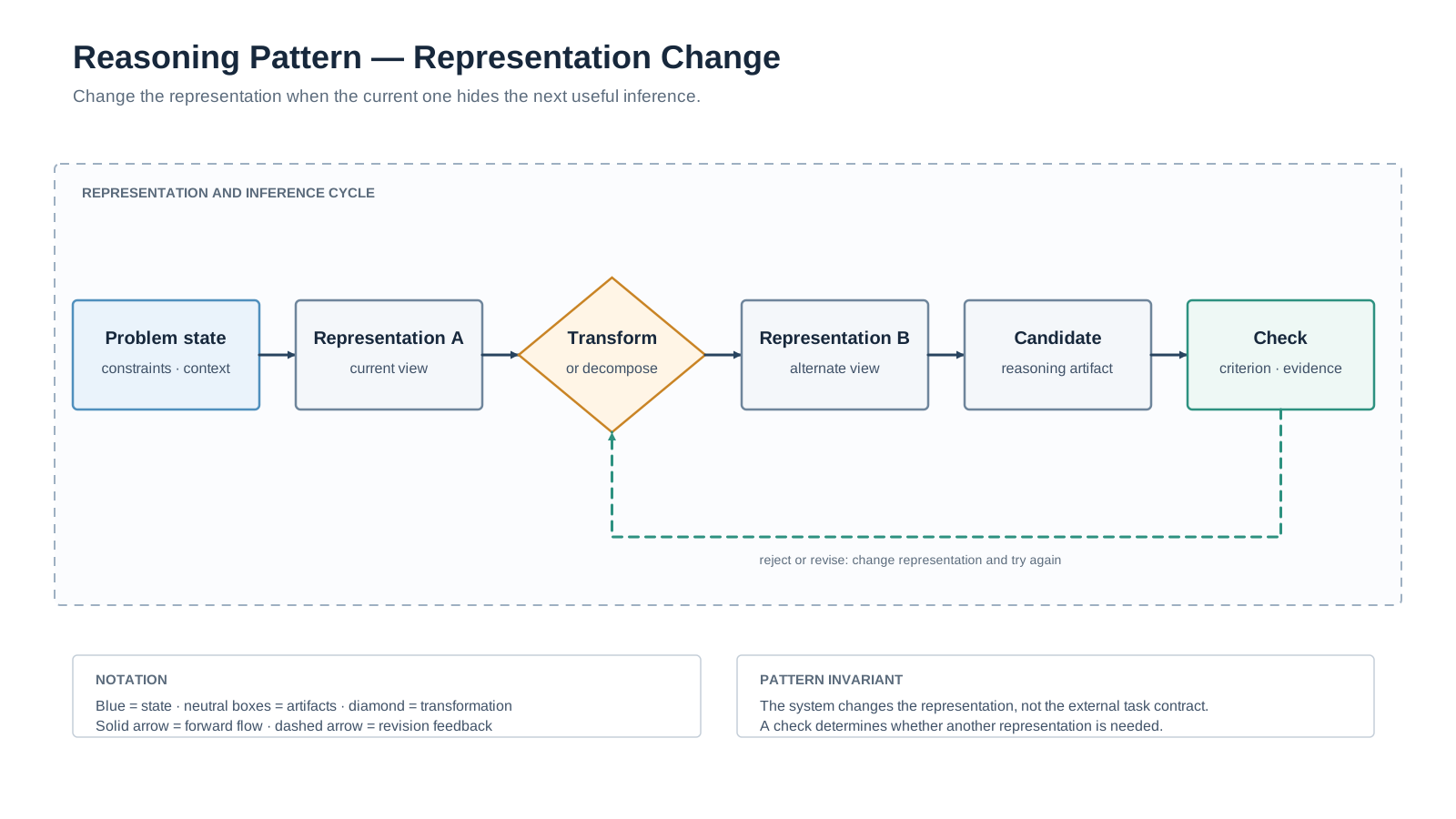
Figure: a course architecture for changing representations when the current view hides the next useful inference. Read it left to right; the dashed loop means that a failed check triggers revision rather than a more confident claim.
In one sentence. When the model is not underpowered but the representation is wrong, change the representation; chains and trees are the two shapes, and a tree pays only when partial work can be judged.
Problem
Some tasks fail because the chosen representation hides the next obstruction, not because the model needs a longer response.
Intent and structure
current representation → transform or decompose → candidate reasoning → check
The system may use linear decomposition, multiple candidate paths, program-aided reasoning, abstraction, analogy, or example generation. The output should be an artifact or proof obligation, not an unbounded private monologue.
Mathematical representation changes
- prose → definitions, claims, and hypotheses;
- geometric picture → invariant, diagram, or coordinate model;
- conjecture → examples and counterexample tests;
- proof idea → lemmas and dependency graph;
- symbolic expression → computer algebra or formal code.
Linear and branching reasoning
Two shapes cover most of what is used in practice. A chain decomposes the problem into ordered steps and commits to each; it is cheap, and it fails when an early commitment was wrong, since nothing revisits it. A tree maintains several partial candidates, evaluates them against a heuristic, and expands or abandons branches deliberately, which buys the ability to backtrack at the cost of a search budget and an evaluation rule.
The choice is not a matter of sophistication. A tree is worth its cost only when the problem admits a meaningful intermediate evaluation — when a partial solution can be judged before it is complete. Where no such judgement exists, branching multiplies cost while selecting essentially at random, and a chain with an independent check afterwards is the better design.
Forces and failure modes
More search can improve coverage but increases cost and distracts from the obstruction. Tree-style exploration can explode; linear reasoning can miss a branch. Use a budget, a verifier, and a criterion for changing representation.
Design test
Which representation makes the next mathematical obstruction visible, and what independent check can reject the resulting candidate?
Real-world application
In root-cause analysis, the same incident can be represented as a timeline, a dependency graph, and a set of competing hypotheses. Representation change is valuable when one view hides a dependency; each proposed explanation still needs tests or evidence before it is accepted.
Reference basis
This page synthesizes Gulli, Agentic Design Patterns, Chapter 17, with the reasoning and representation patterns in Lakshmanan and Hapke, Generative AI Design Patterns, Chapter 5, where chain-of-thought and tree-of-thoughts appear as Patterns 13 and
- The two shapes have primary sources: Wei et al., Chain-of-Thought Prompting Elicits Reasoning in Large Language Models, and Yao et al., Tree of Thoughts: Deliberate Problem Solving with Large Language Models, which makes the state evaluator and the search budget explicit components rather than prompting style. ReAct provides a primary example of interleaving reasoning with information-gathering actions: paper.