
Agent Systems: Reference Books and the Pattern Taxonomy
This course is organized from four complementary books in the Life and Readings vault. The pages are a synthesis and application of their ideas, not a framework-specific API manual.
Four viewpoints
Antonio Gulli — Agentic Design Patterns
This is the broad catalogue: prompt chaining, routing, parallelization, reflection, tool use, planning, multi-agent systems, memory, learning, exception recovery, human-in-the-loop, retrieval, reasoning, safety, evaluation, prioritization, and exploration.
Victor Dibia — Designing Multi-Agent Systems
This book supplies the workflow architecture: explicit computational graphs, autonomous orchestration, sequential/conditional/parallel workflows, handoffs, round-robin interaction, task termination, human delegation, structured output, tools, memory, middleware, observability, checkpointing, persistence, and trajectory evaluation.
Valliappa Lakshmanan and Hannes Hapke — Generative AI Design Patterns
This book gives finer-grained application patterns: constrained generation, RAG stages, deep search, reasoning, reflection, dependency injection, tool calling, code execution, multi-agent collaboration, caching, long-term memory, self-check, reformatting, and guardrails.
Sampriti Mitra — System Design for the LLM Era
This book adds production architecture: gateways, circuit breakers, tiered fallbacks, synchronous versus asynchronous processing, prompt compression, hybrid retrieval, function calling, golden datasets, evaluation, observability, security, caching, latency, and cost.
Course organization
The books are translated into five design questions:
- Control flow: how does work decompose, branch, route, and terminate?
- Knowledge and reasoning: how is context selected and a candidate checked?
- Coordination: how do agents, tools, and humans exchange responsibility?
- Reliability: how are state, failure, evaluation, safety, and resources controlled?
- Architecture: which stable interfaces allow components to be replaced?
Reading rule
Do not use every pattern at once. Choose the smallest composition that makes the important uncertainty observable and the important steps verifiable.
Figure
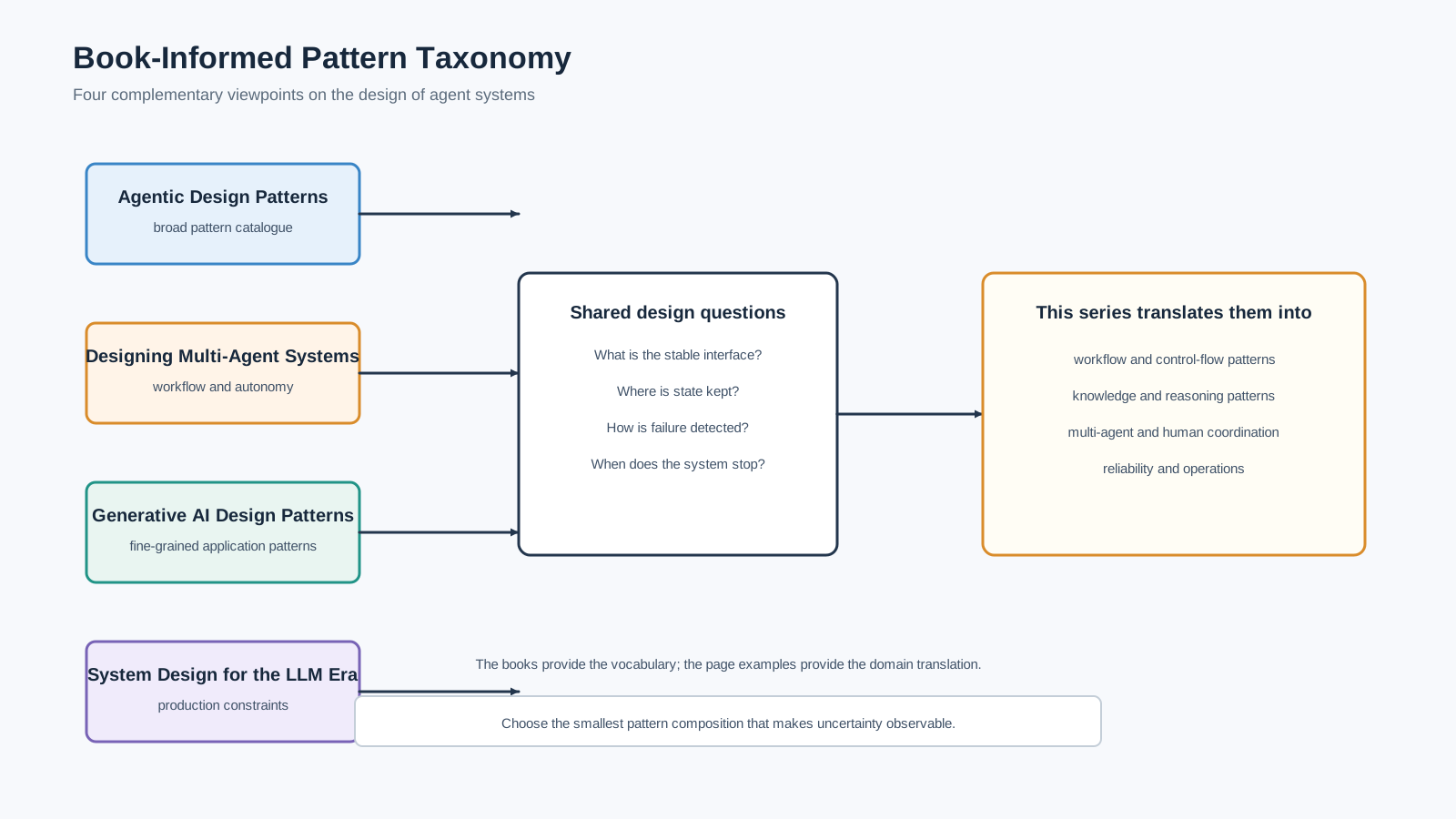
Figure: the four books contribute complementary architectural, application, orchestration, and production viewpoints.