Agent Systems: Reflection Pattern
Figure
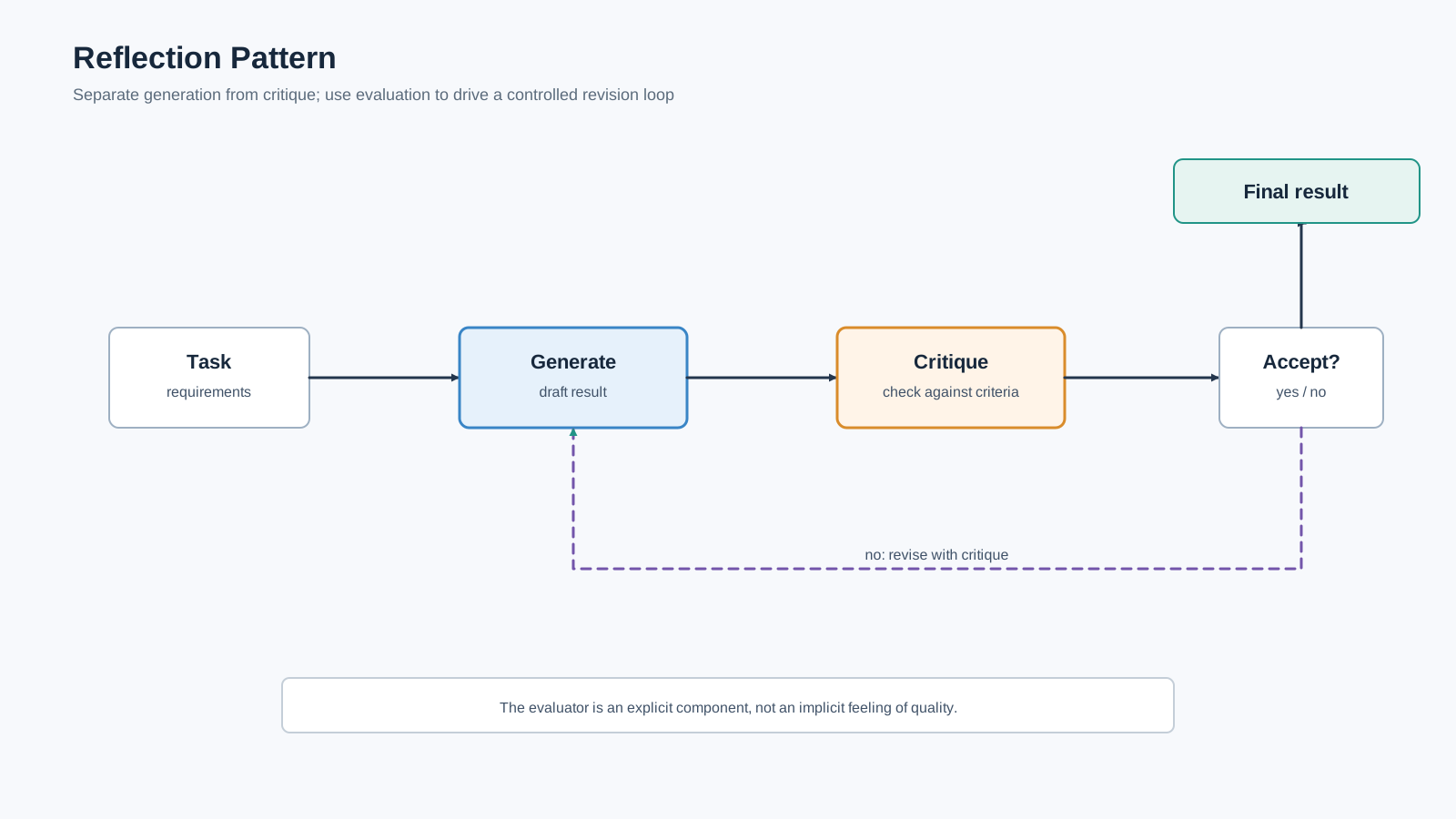
Figure: a draft is evaluated and revised before it is passed onward.
In one sentence. Separate the generator from the critic so quality is checked by something with a different blind spot, and bound the revision loop.
Problem
A first draft can be fluent, incomplete, or subtly inconsistent. Asking for a single answer does not create an independent quality check.
Intent and structure
draft → critique → targeted revision → re-evaluation
The critic may be another model, a deterministic test, a tool, a proof checker, or a human. Good reflection names the violated criterion and returns repairable feedback rather than merely a numerical score.
Separation of roles
The generator should optimize for proposing a useful candidate; the critic should inspect it against explicit requirements. Using the same prompt and context for both can preserve the same blind spot, so independence matters.
Mathematical example
A proof critique checks definitions, hypotheses, quantifiers, theorem applications, and hidden existence claims. The revised proof should preserve the original claim while recording which gap was addressed.
Forces and failure modes
Reflection catches local defects but adds latency and may lead to endless rewriting. Limit revision rounds, retain the rejected draft, and stop when a defined quality threshold or human checkpoint is reached.
Real-world application
In code review or report production, a generator creates a candidate and an independent checker compares it with explicit requirements. The checker should return localized repair instructions, so the workflow can revise one defect and retain the rejected version for audit.
Reference basis
The source pattern is Gulli, Agentic Design Patterns, Chapter 4, and Lakshmanan and Hapke, Generative AI Design Patterns, Pattern 18. The feedback-and-refinement loop is studied directly in Madaan et al., Self-Refine: Iterative Refinement with Self-Feedback.