Agent Systems: Structured Output and Dependency Injection
Figure
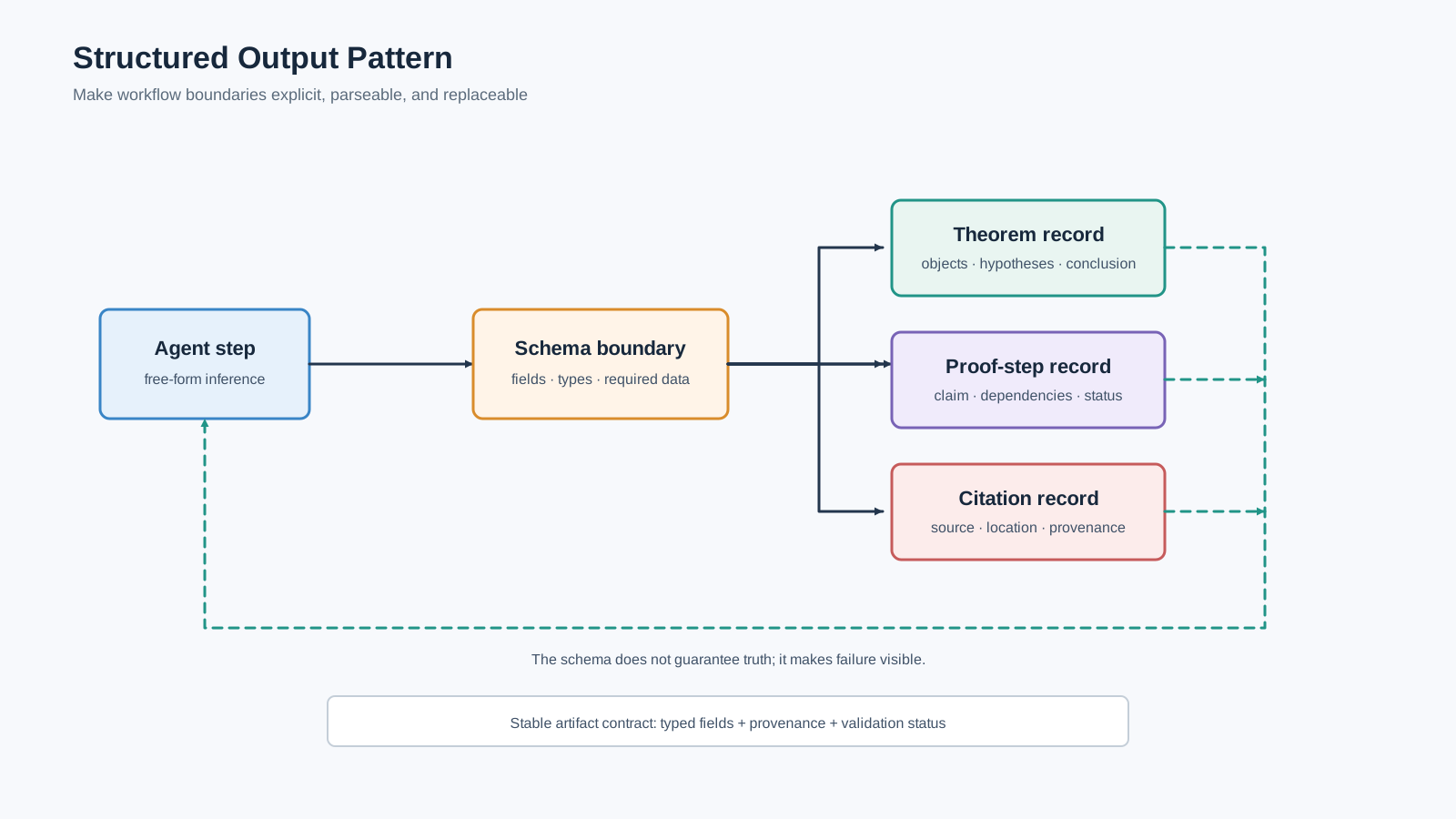
Figure: a schema boundary makes intermediate artifacts parseable without claiming that they are true.
In one sentence. Fix the shape of whatever crosses a boundary, so the next component can consume it instead of interpreting prose.
Problem
Free-form language is ambiguous at a workflow boundary. A downstream component should not have to guess whether a sentence is a claim, an error, a citation, or a request for another action.
Intent and structure
task → schema-constrained artifact → parser/validator → next component
The schema can constrain fields, types, enumerated statuses, or a grammar. It does not make the content true; it makes missing or malformed content visible.
Mathematical artifacts
A theorem record can contain objects, hypotheses, conclusion, source, and status. A proof-step record can contain claim, dependencies, justification, verification status, and repair hints. A citation record can contain source, location, extracted statement, and provenance.
Dependency injection
Pass the model, retriever, checker, or tool into a component through an interface. The component then depends on a capability, not on one concrete implementation. This permits offline tests, model replacement, and controlled experiments.
Forces and failure modes
Schemas improve parsing, testing, and auditing, but overly rigid schemas can discard useful uncertainty. Validate both syntax and semantics, and preserve an explicit unknown, incomplete, or needs_review status.
Real-world application
An underwriting or compliance service can require every model response to be a record containing decision, evidence, uncertainty, and next action. The parser can reject malformed records before they reach a policy engine, while a valid record still remains subject to semantic review.
Reference basis
The interface-first treatment follows Dibia, Designing Multi-Agent Systems, Chapter 4, Section 4.5, “Enabling Structured Output,” together with Lakshmanan and Hapke, Generative AI Design Patterns, the constrained generation patterns in Chapters 1 and 2. The page treats schema validity and truth as separate checks, as required by both sources.