Agent Systems: Variation Points and the Stable Interface
Figure
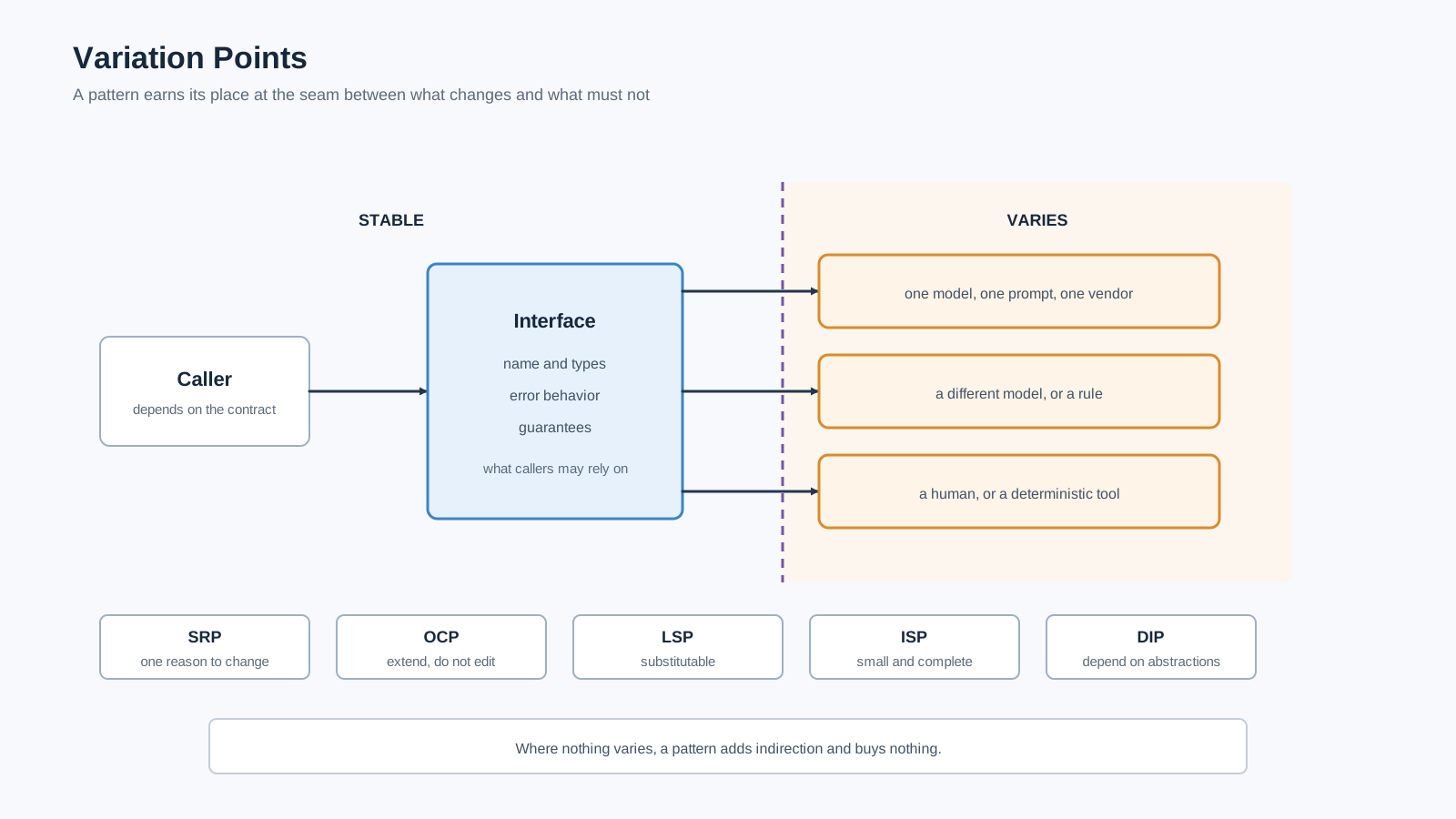
Figure: the seam runs between what callers may rely on and what is free to be replaced. The pattern lives at the seam, not on either side of it.
In one sentence. Every page in this series names a stable interface; this page gives the procedure for finding one, so that a new problem can be handled without a matching page to copy.
The question the series keeps asking
An agent system trades determinism for flexibility. A design pattern buys determinism back at one boundary. That statement is only useful if you can say which boundary — otherwise a pattern is applied by analogy, which is how systems acquire indirection that protects nothing.
The classical answer predates language models by decades, and it is short. Encapsulation means placing a boundary so that one side may change while the other stays fixed. Identify the axis along which the system will actually vary; put the interface across that axis; let the varying side be replaceable and the stable side be depended upon. Applying a design pattern is the act of finding where something changes and where it must not.
The procedure
- Name the change. Not “this might change some day” but a change you can describe: a model will be swapped, a second retrieval source will be added, a critic will sometimes be a human and sometimes a test.
- Locate the axis. What varies along it, and what must every variant still provide?
- Write the contract for what every variant provides: names, types, error behavior, guarantees. This is the stable side.
- Check the direction of dependence. Callers depend on the contract, never on a variant. If replacing a variant edits the caller, the seam is misplaced.
- Test the seam by naming the second implementation. If you cannot name a plausible one, you have found no axis, and the pattern is decoration.
Step 5 is the one most often skipped, and it is the cheapest guard against over-engineering in the whole series.
The five principles, restated for agent systems
- Single responsibility. A component should have one reason to change. An orchestrator that also judges correctness has two, and the two will conflict the first time a strict verdict blocks progress.
- Open–closed. Adding a route, a tool, or a critic should extend a registry, not edit the loop. If every new capability touches the control flow, the system is closed to extension exactly where it needs to be open.
- Liskov substitution. Any handler behind a router must honor the router’s result contract. A handler that returns a different shape on failure is not a substitute, and the caller will grow a special case for it.
- Interface segregation. Expose small, complete tool surfaces. An agent given a tool it never needs has a capability you must reason about in every safety review; this is the same argument as least privilege, arrived at from design rather than from security.
- Dependency inversion. High-level policy and low-level implementation should both depend on an abstraction. Concretely: the orchestrator depends on “a critic returning a verdict”, not on a particular model with a particular prompt.
Prefer composition to inheritance carries over unchanged, and is why this series treats patterns as things you combine rather than a hierarchy you specialize.
Worked application
Router. The change is that task classes will be added. The axis is the task class; every variant must still return a result in one shape. The contract is therefore the routing label, the selected capability, the confidence or rationale, and the fallback. Note what this excludes: the classifier’s implementation is on the varying side, so a rule table today and a model tomorrow are both admissible without touching callers.
Reflection. The change is who criticizes — a second model, a unit test, a proof checker, a human. The axis is the critic; every variant must return a named violated criterion and repairable feedback. Once that contract is written, the argument for critic independence stops being a matter of taste: the generator and the critic are separate variants precisely because they must be able to differ.
Where the procedure says no. If a system will only ever call one model with one prompt and no second implementation is imaginable, a “model abstraction layer” has no axis. It adds a file and protects nothing.
Mathematical application
The habit transfers directly. A definition is an interface: it fixes what may be relied on and leaves the construction free. A theorem’s hypotheses are the contract; its proof is one implementation. Generalizing a theorem is finding the axis along which the hypotheses may vary while the conclusion survives — which is the same move as widening an interface, and fails in the same way when the proof secretly used something the hypotheses did not promise.
This is also the sharpest available test of whether a research agent is well designed. If replacing the theorem-search backend requires rewriting how proofs are checked, then search and judgment were never separated, and no amount of prompting will separate them later.
Forces and failure modes
Every seam costs a layer. Seams placed on imagined axes produce configuration that nobody varies and interfaces with one implementation; seams omitted on real axes produce rewrites. The asymmetry worth knowing is that a missing seam is usually cheaper to add later than a wrong seam is to remove, because the wrong seam has already been depended upon.
Exercises
- Take three pages from Parts II–V. For each, state the axis of variation in one sentence and name a second implementation. Which page’s contract is weakest?
- Find an interface in your own system with exactly one implementation. Is there a nameable second one? If not, what would be lost by removing the interface?
- A team proposes an “LLM provider abstraction layer” for a system that calls one model. Argue both sides using step 5, then decide.
- State the contract a proof checker must satisfy for the generator to be indifferent to whether the checker is a model, a proof assistant, or a person.
- Take a theorem you know well. Name the axis along which its hypotheses could vary, and say which step of the proof is the caller that depends on them.
Reference basis
The principles are classical rather than recent. Information hiding — placing boundaries so that a design decision can change behind one — is D. L. Parnas, “On the criteria to be used in decomposing systems into modules,” Communications of the ACM 15 (1972), no. 12, 1053–1058. The formulation of a pattern as a recurring problem with a reusable solution, together with the guidance to encapsulate what varies and to prefer composition to inheritance, is E. Gamma, R. Helm, R. Johnson, and J. Vlissides, Design Patterns: Elements of Reusable Object-Oriented Software, Addison-Wesley, 1994. The open–closed principle is B. Meyer, Object-Oriented Software Construction, Prentice Hall, 1988, and the five principles are collected as SOLID in R. C. Martin, “Design Principles and Design Patterns,” 2000. The application to agent systems is this course’s synthesis: none of the four pattern books state the selection rule in these terms, though Dibia, Designing Multi-Agent Systems, Chapter 2, Sections 2.1–2.4, reaches a compatible conclusion from the other direction by recommending the simplest structure that meets the requirement.