Agent Systems: The Verification Gate
Figure
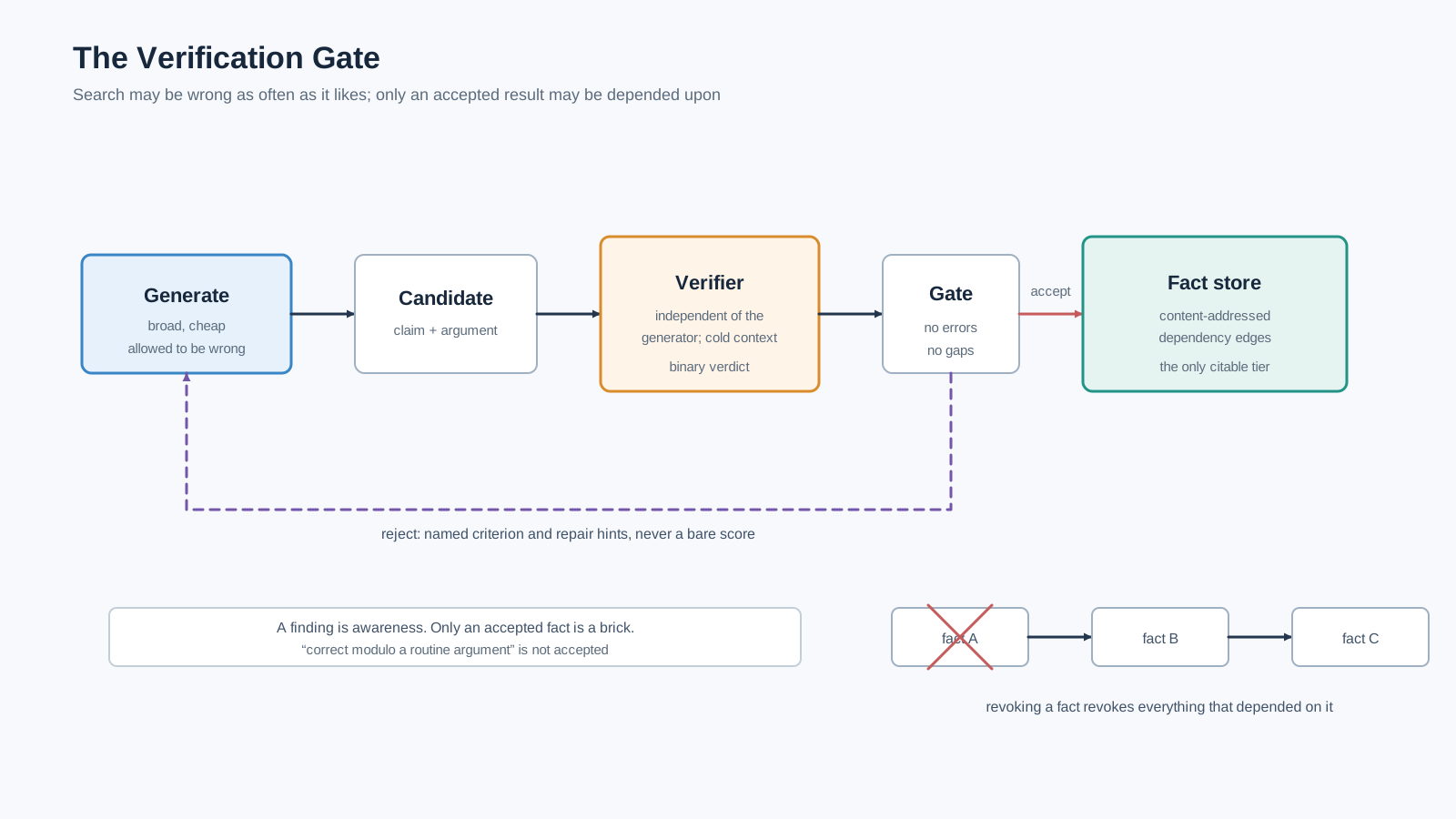
Figure: generation is broad and may be wrong; a single gate decides what is allowed to become something other results depend on.
In one sentence. Separate the tier of things the system has produced from the tier of things it may build on, and let nothing cross between them except through an independent verdict.
Problem
Reflection improves a draft. It does not answer a different question: once a result is produced, may other work depend on it?
Without an answer, an agent’s outputs form a flat pool in which a checked lemma, an unchecked lemma, and a plausible-sounding guess are indistinguishable. The damage compounds. A later step cites the guess, a third step cites the second, and by the time the error surfaces there is no way to determine what is contaminated without redoing everything. This is the characteristic failure of long-running research systems, and no amount of care inside any single step prevents it, because the defect is in the absence of a tier boundary rather than in the quality of the reasoning.
Intent and structure
candidate → independent verifier → binary verdict → gated write → dependency graph
Four commitments make this a pattern rather than an intention.
The verifier is independent. Different context, ideally a cold one, and no access to the generator’s reasoning. A critic that inherits the generator’s context inherits its blind spot, and self-assessment then measures fluency instead of correctness.
The verdict is binary. A result is accepted only with zero critical errors and zero gaps. “Correct modulo a routine argument” is not accepted. This rule looks harsh and is the entire load-bearing element: the moment a partial verdict can be stored, the tier distinction is gone and the store is back to being a pool of assertions with optimistic labels.
The write is gated by role. The component that generates cannot be the component that admits. If a worker can write to the store directly, the gate is advisory, and an advisory gate is not a gate.
Dependencies are recorded. Each accepted result names what it was derived from. This is what makes an error survivable: when a fact is revoked, everything downstream is revoked with it, mechanically, without a judgment call about how far the damage reached.
Stable interface
An accepted record carries the statement, the argument, the verdict with its criteria, the verifier’s identity and version, the dependencies by identifier, and a content address. Content addressing matters more than it appears to: if the statement is edited, the identifier changes, so a silent revision cannot masquerade as the thing that was verified.
The rejection path needs a contract too. A rejection returns the violated criterion and repairable feedback, never a bare score, since a score tells the generator that something is wrong without telling it what to change.
Mathematical application
This is the pattern’s home ground, and the one place where its strictness is uncontroversial. Search over proof strategies is enormously productive and enormously unreliable; the two facts are compatible only if the system distinguishes what it tried from what it established.
Concretely, the tiers separate as: conjectures and heuristics, which may be stored freely and cited as motivation; findings, which record what an exploration observed; and facts, which have passed the gate and may be used as lemmas. Only the third tier is citable in a proof. A retrieved theorem is not a fact about the current problem until its hypotheses have been checked against the current hypotheses — which is why retrieval and verification are different patterns, and why a successful retrieval with mismatched hypotheses is the most dangerous output the system can produce.
The discipline pays off precisely when something goes wrong. If a lemma accepted in week two is found defective in week six, the dependency graph answers “what else falls?” in one query, rather than by rereading six weeks of work.
Forces and failure modes
A strict gate is slow and rejects work that is probably fine, and the pressure to relax it is constant and reasonable-sounding. The failure modes are worth naming because each is a specific way of keeping the gate while losing its value: verifier capture, where the generator learns to produce what the verifier accepts rather than what is correct; gate erosion, where a “provisional” tier is added and gradually becomes citable; and unrecorded dependencies, which leave the graph unable to cascade and so silently convert revocation into a manual audit.
Independence is also expensive. A cold-context verifier re-reads material the generator already has in context, and this cost is the price of the independence, not an inefficiency to optimize away.
Real-world application
The pattern generalizes past mathematics wherever a system accumulates results over time: a compliance assistant that separates retrieved policy text from its own interpretation, a data pipeline that separates validated records from inferred ones, a code agent that separates tests that pass from changes that merely compile. In each case the question is the same — what may the next step treat as settled — and in each case the answer must be a property of the store rather than of anyone’s confidence.
Exercises
- In a system you have built, classify every persisted item as conjecture, finding, or fact. Which items are cited as if they were facts but were never gated?
- Design the rejection contract for a proof checker so that a generator can act on it without seeing the checker’s full reasoning. What is the minimum it must return?
- A worker proposes a lemma the verifier accepts, and a later verifier version would reject it. What does the record need for this to be detectable?
- Argue the case for a “provisional” tier, then show concretely how it becomes citable within six months. What control would prevent that?
- Compare the cost of a cold-context verifier against a critic sharing the generator’s context, on a task where the generator’s premise is wrong.
Reference basis
The pattern is a generalization of the correctness boundary in the Danus and Rethlas case study on the case-study page, where a role-gated write path admits only verifier-accepted results into a content-addressed fact graph. Its components appear separately in the pattern books: reflection and critique in Gulli, Agentic Design Patterns, Chapter 4, and the trustworthy-generation, LLM-as-Judge, and self-check patterns in Lakshmanan and Hapke, Generative AI Design Patterns, Patterns 11, 17, and 31. What the books treat as quality improvement on a single output becomes, when combined with a gated write and a dependency graph, a constraint on what the system is permitted to accumulate. Dibia, Designing Multi-Agent Systems, Chapter 10, supplies the corresponding evaluation vocabulary, and the plan-approve-execute control in Mitra, System Design for the LLM Era, Chapter 2, is the same separation applied to actions rather than to claims.