Agent Systems: Real-World Architecture Templates
The useful question is not “which framework has this pattern?” It is “what real problem needs this boundary?” The figure below treats each pattern as an architecture decision: a task enters, responsibilities cooperate through explicit interfaces, and the system leaves behind an artifact or verdict that can be inspected.
Five real problems
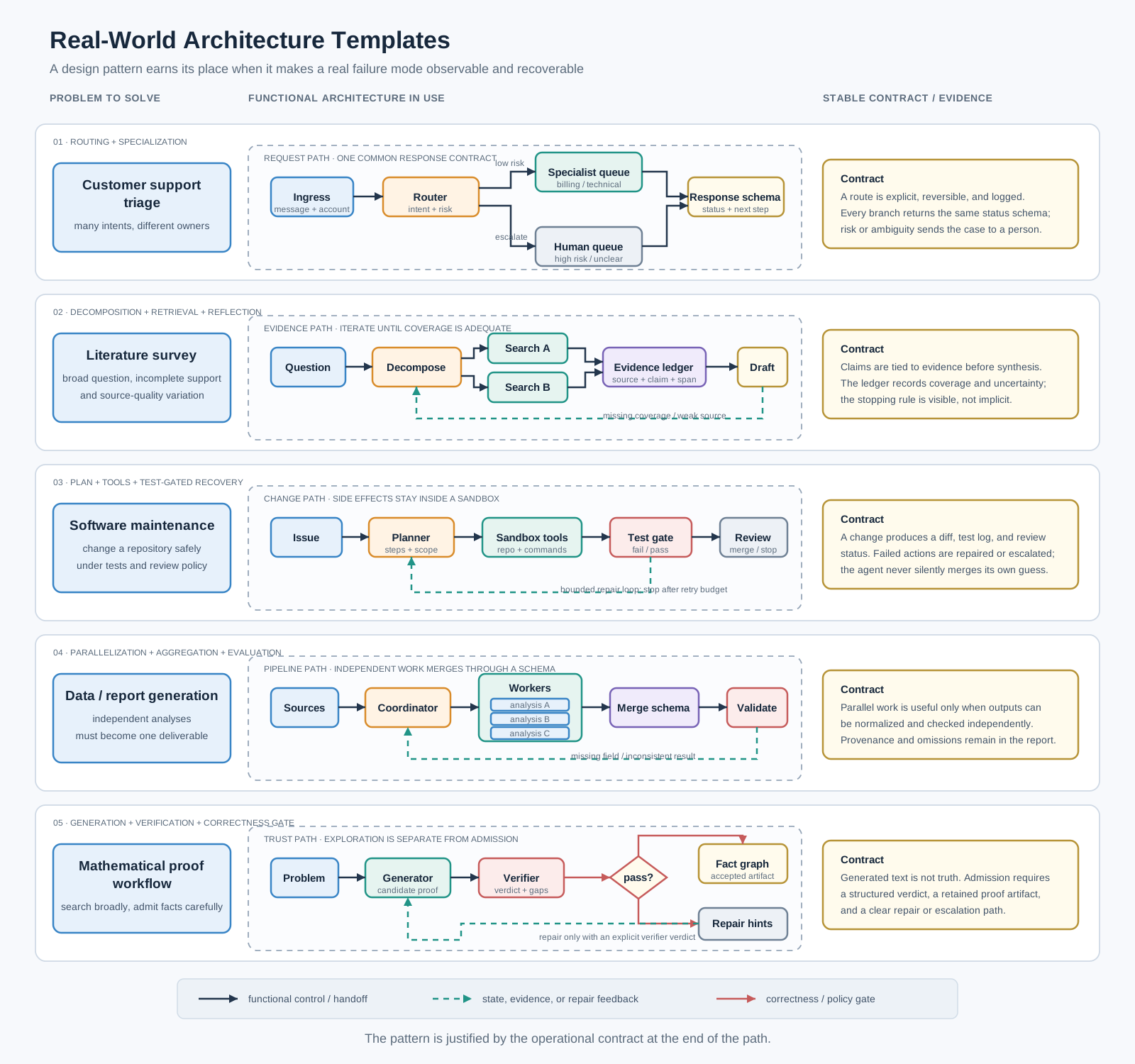
Figure: five application architectures. Solid navy arrows are functional control or handoff; dashed teal arrows are state, evidence, or repair feedback; red arrows are correctness or policy gates. The diagrams are course syntheses, not claims that every implementation needs every component.
1. Customer support triage
When many intents have different owners, the router is not merely a classifier: it is a responsibility boundary. Specialist work and human escalation must return a common response schema, so downstream systems do not need to know which branch handled the request.
2. Literature survey
When a question is broad and sources vary in quality, decomposition and parallel retrieval reduce blind spots. An evidence ledger makes the important intermediate object explicit: source, claim, and supporting span. Reflection is then a coverage check, not a vague request to “try again.”
3. Software maintenance
For repository changes, planning, tool use, tests, and review form a bounded control loop. The sandbox contains side effects; the test gate turns failure into a repair signal; the review boundary prevents a fluent but unverified patch from becoming a merged change. The reality of this task shape is also captured by the SWE-bench benchmark, which evaluates issue resolution against real repositories and tests.
4. Data and report generation
Parallelization is appropriate only when branches are independent and their outputs can be normalized. A merge schema, provenance fields, and independent validation are the architecture that turns several analyses into one auditable deliverable.
5. Mathematical proof workflow
Proof generation and proof admission should have different responsibilities. The generator may explore broadly, while the verifier emits a structured verdict and repair hints. Only the correctness gate admits an artifact into a fact graph or report. This is the same boundary documented in the Danus and Rethlas code case study, without exposing any private research framework.
A practical selection rule
Choose a pattern from the operational problem:
- use routing when ownership, intent, or risk changes the next handler;
- use decomposition and retrieval when the initial context is incomplete;
- use planning, tools, and recovery when actions have side effects;
- use parallelization when work is independent and mergeable;
- use verification, checkpoints, or human review when an incorrect result is costly.
Then define the contract before choosing the model: input schema, intermediate artifact, evidence format, evaluator, retry budget, and stopping rule. If those items cannot be named, the “pattern” is probably only a slogan.
Relation to the reference material
The architecture forms are teaching redraws synthesized from the course books: Gulli’s Agentic Design Patterns, Dibia’s Designing Multi-Agent Systems, Lakshmanan and Hapke’s Generative AI Design Patterns, and Mitra’s System Design for the LLM Era. Their recurring structures are also visible in ReAct’s reasoning/action loop (paper), STORM’s evidence-oriented research workflow (paper), and Magentic-One’s orchestrator-led multi-agent workflow (technical report). The pattern vocabulary and cross-book comparison are collected on the reference map.
Source rule
The named systems above are evidence for the existence of related structures; they are not evidence that a proposed architecture will work automatically in every domain. The five rows in this page are design templates. Any deployment should validate its own quality, cost, safety, and failure behavior with a domain-specific evaluation set.